By virtue of the authority vested in me as President of the United States and in accordance with the provisions of the Department of Housing and Urban Development Act, as amended (42 U.S.C. 3531 et seq.), Title VIII of the Housing Act of 1964, as amended (20 U.S.C. 801 et seq.), and Title V of the Housing and Urban Development Act of 1970 (12 U.S.C. 1701z-1 et seq.), it is ordered as follows: SECTION 1. Policy. The Nation's housing stock represents an important national resource which must be preserved and well managed if public and private investments are to be protected, and if we are to meet our goal of providing a decent home and suitable living environment for low and moderate income residents. The production of Federally-assisted housing has greatly expanded in recent years, creating a need for a balanced strategy to ensure that such housing remains viable for the purposes intended. This expansion also creates a need for a growing supply of new management manpower for the years ahead. Special skills must, be developed among these managers so that they can effectively overcome the social and economic problems facing many residents of Federally-assisted housing, including the elderly. Training, the improvement of career opportunities, and the upgrading of industry standards are all essential to the improvement of the Nation's housing management capability, particularly for low and moderate income housing. SEC. 2. Establishment of a National Center for Housing Management. (a) The Secretary of Housing and Urban Development is directed to call upon public-spirited citizens, dedicated and experienced in the appropriate disciplines, to create, in accordance with existing laws, a new, non-governmental, not-for-profit institution to serve as a National Center for Housing Management (referred to herein as the Center). (b) The Center should be designed to provide objective and independent leadership at the national level in helping meet the Nation's housing management and training needs and should work cooperatively with the Department of Housing and Urban Development and with the public and private organizations and institutions involved in, or affected by, its activities. SEC. 3. Activities of the Center. The activities of the Center should be developed along lines that include the following objectives: (1) Development of training and educational programs for housing management and personnel; (2) Cooperation with public and private national, State, and local organizations and institutions in extending housing management training and educational opportunities, using to the fullest extent possible the services and facilities of existing agencies with expertise in training and education; (3) Cooperation with national, State, and local organizations and institutions in establishing or expanding recruitment and placement systems that will link training in housing management to job opportunities in that field; (4) Development of improved housing management practices and assistance in professionalizing the housing management industry; and (5) Stimulating the creation of new management entities, and strengthening the effectiveness of existing management entities. SEC. 4. Assistance by Federal Agencies. To the extent consistent with law, all other Federal executive departments and agencies shall cooperate and work with the Department of Housing and Urban Development and the Center in providing appropriate advice and financial support so as to ensure that the above described objectives are carried out with the most effective and efficient use of Federal, State and local resources, both public and private. RICHARD NIXON The White House, April 21, 1972
Executive Order 11668 🏛️✅ Zone 1: Maximum Authority Constitutional Fidelity (+0.29)
📜 10th Amend: Intergovernmental Federalism Cooperation
Executive Order 11668—Providing for a National Center for Housing Management
Executive Brief • At a Glance
⏱️ 3 min read (557 words) •
● In Effect
🎯 Primary Mandate
The production of Federally-assisted housing has greatly expanded in recent years, creating a need for a balanced strategy to ensure that such housing remains viable for the purposes intended.
⚖️ Constitutional Footing
🏛️✅ Zone 1: Maximum Authority
Express or Implied Congressional Authorization
📜 10th Amend: Intergovernmental Federalism Cooperation
🏛️ Scope & Affected Sectors
Sovereign State Governments & Localities Executive Departments & Federal Civil Servants Private Citizens & Property Owners Foreign Nations & International Entities
Plain-English Translation & Framers' Constitutional Analysis
Early Statesman synthesis distilling legal jargon into practical meaning, statutory anchors, and structural constitutional impacts.
Signed by President Richard Nixon on April 21, 1972, this order concerns Providing for a National Center for Housing Management. Policy. The Nation's housing stock represents an important national resource which must be preserved and well managed if public and private investments are to be protected, and if we are to meet our goal of providing a decent home and suitable living environment for low and moderate income residents.
Constitutional Assessment: Reviewed under the Tenth Amendment and the principle of dual federalism, this order touches upon domains traditionally reserved to the sovereign States. The Framers would caution against any attempt to commandeer state officers or displace local police powers through federal executive fiat.
Key Directives & Operative Actions
▪
The production of Federally-assisted housing has greatly expanded in recent years, creating a need for a balanced strategy to ensure that such housing remains viable for the purposes intended.
▪
This expansion also creates a need for a growing supply of new management manpower for the years ahead.
▪
The Secretary of Housing and Urban Development is directed to call upon public-spirited citizens, dedicated and experienced in the appropriate disciplines, to create, in accordance with existing laws, a new, non-governmental, not-for-profit institution to serve as a National Center for Housing Management (referred to herein as the Center).
▪
The activities of the Center should be developed along lines that include the following objectives: (1) Development of training and educational programs for housing management and personnel; (2) Cooperation with public and private national, State, and local organizations and institutions in extending housing management training and educational opportunities, using to the fullest extent possible the services and facilities of existing agencies with expertise in training and education; (3) Cooperation with national, State, and local organizations and institutions in establishing or expanding recruitment and placement systems that will link training in housing management to job opportunities in that field; (4) Development of improved housing…
Constitutional & Societal Entities Impacted
🏛️ Sovereign State Governments & Localities
🏛️ Executive Departments & Federal Civil Servants
🏛️ Private Citizens & Property Owners
🏛️ Foreign Nations & International Entities
Policy Areas & Topics
🏛️
The Framers' Constitutional Council
1787 PrismEvaluating this order against the constitutional debates of 1787 and the limits of Article II executive power.
🏛️✅ Zone 1 (Maximum Authority)
§
"When the President acts pursuant to an express or implied authorization of Congress, his authority is at its maximum, for it includes all that he possesses in his own right plus all that Congress can delegate."
— Justice Robert H. Jackson, Youngstown Sheet & Tube Co. v. Sawyer (1952) Express or Implied Congressional Authorization
JM
James Madison
Separation of Powers & Legislative Primacy
"The constitutional magistracy was designed not to invent policy, but to be the faithful instrument of the laws passed by the people's representatives." — Speech in the First Congress (1789)
Madison would approve the structural posture of this order. The President acts strictly in subordination to statutory authority granted under Article II, Section 3 ("take Care that the Laws be faithfully executed"). The checks and balances hold firm because the policy origin remains with the legislature.
Madisonian Stance: Concurring (Statutory)
AH
Alexander Hamilton
The Energetic Executive & Unified Command
"A feeble Executive implies a feeble execution of the government; and a government ill executed, whatever it may be in theory, must be, in practice, a bad government." — Federalist No. 70 (1788)
Hamilton would view this directive as the natural and indispensable functioning of administrative leadership. Without the power to coordinate agencies, manage personnel, and resolve operational ambiguities, the modern presidency would be reduced to an impotent figurehead.
Hamiltonian Stance: Supportive of Execution
GM
George Mason
Bill of Rights, Due Process & 10th Amendment
"The powers not delegated to the United States by the Constitution, nor prohibited by it to the States, are reserved to the States respectively, or to the people." — 10th Amendment to the US Constitution (1791)
Mason would scrutinize whether this federal directive intrudes into police powers, land stewardship, or municipal domains historically reserved to local citizens. The Anti-Federalist demand is that federal administration must never supplant state self-governance.
Anti-Federalist Stance: Eternal Vigilance Required
📐
Five Measurable "Constitutional Friction" Dimensions
An objective audit measuring potential separation-of-powers tension against the United States Constitution and established Supreme Court doctrine.
⚖️ Discretionary Twilight Zone
35 / 100 friction index
Dimension 1 • Art. I, §1 & §8
Moderate Friction
Legislative Encroachment & Purse
Administers commerce or fiscal programs requiring ongoing statutory delegation and legislative oversight.
Benchmark: Power of the purse, taxes/tariffs, and rule of law reserved to Congress.
Dimension 2 • Art. II, §1 & §3
Low Friction
Executive Scope & Faithfulness
Exercises standard supervisory executive authority to faithfully execute existing statutes.
Benchmark: Faithfully execute laws enacted by Congress vs. unilateral decree.
Dimension 3 • 10th Amendment
Moderate Friction
Federalism & State Sovereignty
Engages state and local partners in cooperative federalism programs.
Benchmark: Police powers and un-delegated responsibilities reserved to the States.
Dimension 4 • 5th & 14th Amendments
Moderate Friction
Due Process & Individual Rights
Applies regulatory or compliance standards to private contractors or commercial entities.
Benchmark: Protection of private property, contracts, liberty, and procedural justice.
Dimension 5 • Separation of Powers
Low Friction
Youngstown Jacksonian Tier
The President operates strictly as the constitutional Chief Executive, carrying out policy established by Congress with strong statutory backing.
Benchmark: Express or Implied Congressional Authorization
⚖️
Audit Synthesis
This order operates within Justice Jackson’s Zone of Twilight, resting upon concurrent presidential authority or congressional silence.
Weighted composite: Art. I (25%), Art. II (25%), Federalism (15%), Due Process (15%), Youngstown (20%).
ℹ️
How to read these dimensions: Executive power expands whenever an administration acts without explicit statutory authorization from Congress (Article I), touches upon police powers historically reserved to the states (Tenth Amendment), or limits private rights and property without judicial process. A low friction score indicates strict concordance with enacted law; a high friction score highlights orders testing the limits of presidential discretion.
Total Words
557
3,705 characters
Estimated Read Time
3 min
@ 200 words / min
Flesch-Kincaid
17.3
Post-Graduate Legal
Text size:
Related Executive Orders
Other executive actions signed by Richard Nixon around this period.
EO 11667 Apr 19, 1972
🏛️✅ Zone 1 (Maximum Authority) Fidelity (+0.29)
Executive Order 11667—Establishing the President's Advisory Committee on the Environmental Merit Awards Program
📜 5th Amend: Regulatory Execution with Due Process
There is hereby established the President's Advisory Committee on the Environmental Merit Awards Program. The Committee shall be composed of a Chairman, to be designated by the President, and such members as the President may, from time to time, appoint.
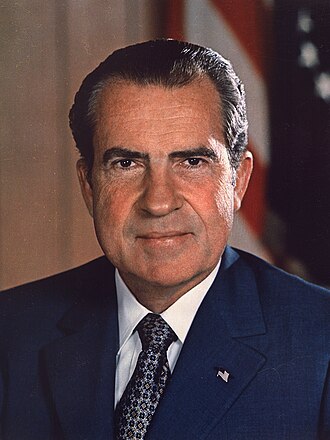 Richard Nixon
Post-Graduate Legal • 2m
EO 11666 Apr 11, 1972
🏛️✅ Zone 1 (Maximum Authority) Constitutional Neutral
Executive Order 11666—Qualification for the Investment Credit on Certain Articles and Classes of Articles of Predominantly Foreign Origin
📜 Art. I §8: Delegated Tariff & Commerce Execution
Section 48 (a) (7) (A) shall not apply to an acquisition by the taxpayer of: (a) Any article the unit cost of which to the taxpayer is not in excess of $500; or (b) Agricultural implements, machinery, and equipment which are determined by the Secretary of the Treasury to be…
Richard Nixon Post-Graduate Legal • 1m
EO 11669 May 2, 1972
⚖️✨ Zone 2 (Zone of Twilight) Constitutional Neutral
Executive Order 11669—J. Edgar Hoover
📜 Art. II §2: Commander-in-Chief Supervisory Authority
Pursuant to the provisions of Section 4 of Proclamation 3044 of March 1, 1954, as amended, that until interment the flag of the United States shall be flown at half-staff on all buildings, grounds and naval vessels of the Federal Government in the District of Columbia and…
Richard Nixon College Level • 1m
EO 11665 Apr 10, 1972
⚖️✨ Zone 2 (Zone of Twilight) Constitutional Neutral
Executive Order 11665—James F. Byrnes
📜 Art. II §2: Commander-in-Chief Supervisory Authority
Pursuant to the provisions of Section 4 of Proclamation 3044 of March 1, 1954, as amended, that until interment the flag of the United States shall be flown at half-staff on all buildings, grounds and naval vessels of the Federal Government in the District of Columbia and…
Richard Nixon College Level • 1m
EO 11664 Mar 31, 1972
⚖️✨ Zone 2 (Zone of Twilight) Constitutional Neutral
Executive Order 11664—Creating an Emergency Board to Investigate a Dispute Between the Penn Central Transportation Company and Certain of Its Employees
📜 Art. II §1: Executive Discretion & Internal Operations
I hereby create a Board of three members, to be appointed by me, to investigate this dispute. No member of the Board shall be pecuniarily or otherwise interested in any organization of railroad employees or any carrier.
Richard Nixon Post-Graduate Legal • 1m
EO 11663 Mar 31, 1972
⚖️✨ Zone 2 (Zone of Twilight) Constitutional Neutral
Executive Order 11663—Creating an Emergency Board to Investigate Disputes Between the Carriers Represented by the National Railway Labor Conference and Certain of Their Employees
📜 Art. II §1: Executive Discretion & Internal Operations
I hereby create a board, of three members, to be appointed by me, to investigate these disputes. No member of the board shall be pecuniarily or otherwise interested in any organization of railroad employees or any carrier.
Richard Nixon Post-Graduate Legal • 1m
📜
Scholarly & Legal Citations
Exec. Order No. 11,668 (Apr. 21, 1972), https://executiveordersarchive.org/orders/app-executive-order-11668-providing-for-national-center-for-housing-management.
