CIRCULAR. * *Sent to all diplomatic and consular officers of the United States. DEPARTMENT OF STATE, Washington, February 29, 1844. SIR: It has become my most painful duty to announce to you the sudden and violent death of the Hon. Abel P. Upshur, late Secretary of State of the United States. This afflicting dispensation occurred on the afternoon of yesterday, from the bursting of one of the great guns on board the Government steamship Princeton , near Alexandria, on her return from an excursion of pleasure down the river Potomac. By this most unfortunate accident several of our distinguished citizens, amongst whom were the Secretaries of State and of the Navy, were immediately killed, and many other persons mortally wounded or severely injured. It is the wish of the President that the diplomatic and consular agents of the United States, and all other officers connected with the State Department, either at home or abroad, shall wear the usual badge of mourning, in token of their grief and of respect for the memory of Mr. Upshur, during thirty days from the time of receiving this order. In consequence of this event, the President has been pleased to charge me ad interim with the direction of the Department of State, and I have accordingly this day entered upon the duties of this appointment. I have the honor to be, with great respect, sir, your obedient servant, JNO. NELSON. GENERAL ORDERS. WAR DEPARTMENT, February 29, 1844. In the deepest grief the President of the United States has instructed the undersigned to announce to the Army that from the accidental explosion of a gun yesterday on board the United States steamship Princeton the country and its Government lost at the same moment the Secretary of State, the Hon. A. P. Upshur, and the Secretary of the Navy, the Hon. T. W. Gilmer. Called but a few days since to preside over the administration of the War Department, it is peculiarly painful to the undersigned that his first official communication to the Army should be the announcement of a calamity depriving the country of the public services of two of our most accomplished statesmen and popular and deeply esteemed fellow-citizens. Their virtues, talents, and patriotic services will ever be retained in the grateful recollection of their countrymen and perpetuated upon the pages of the history of our common country. Deep as may be the gloom which spreads over the community, it has pleased the Almighty Disposer of Events to add another shade to it by blending in this melancholy catastrophe the deaths of an eminent citizen, Virgil Maxcy, esq., lately charge' d'affaires to Belgium; a gallant and meritorious officer of the Navy, a chief of a bureau, Captain B. Kennon, and a private citizen of New York of high and estimable character, besides others, citizens and sailors, either killed or wounded. As appropriate honors to the memory of these distinguished Secretaries, half-hour guns will be fired at every military post furnished with the proper ordnance the day after the receipt of this order from sunrise to sunset. The national flag will be displayed at half-staff during the same time. And all officers Of the Army will wear for three months the customary badge of mourning. WM. WILKINS, Secretary of War. NAVY DEPARTMENT, February 29, 1844. As a mark of respect to the memory of the late Hon. Thomas W. Gilmer, Secretary of the Navy, whose career at his entrance upon the duties of his office, would have been nobly maintained by that ability and vigor of which his whole previous life had been the guaranty, the flags of all vessels in commission, navy-yards, and stations are to be hoisted at half-mast on the day after the receipt of this order, minute guns to the number of seventeen are to be fired between sunrise and sunset, and crape is to be worn on the left arm and upon the sword for the space of three months. By command of the President: L. WARRINGTON, Secretary of the Navy ad interim.
Presidential Order
🏛️✅ Zone 1: Maximum Authority Constitutional Fidelity (+0.38)
📜 Art. II §2: Commander-in-Chief Supervisory Authority
Executive Order
Executive Brief • At a Glance
⏱️ 3 min read (673 words) •
● In Effect
🎯 Primary Mandate
It is the wish of the President that the diplomatic and consular agents of the United States, and all other officers connected with the State Department, either at home or abroad, shall wear the usual badge of mourning, in token of their grief and of respect for the memory of Mr. Upshur, during thirty days from the time of receiving this order.
⚖️ Constitutional Footing
🏛️✅ Zone 1: Maximum Authority
Express or Implied Congressional Authorization
📜 Art. II §2: Commander-in-Chief Supervisory Authority
🏛️ Scope & Affected Sectors
Armed Forces & Military Establishments Merchants, Importers & Commercial Enterprises Sovereign State Governments & Localities Executive Departments & Federal Civil Servants
Plain-English Translation & Framers' Constitutional Analysis
Early Statesman synthesis distilling legal jargon into practical meaning, statutory anchors, and structural constitutional impacts.
Signed by President John Tyler on February 29, 1844, this order reads: CIRCULAR. * *Sent to all diplomatic and consular officers of the United States. DEPARTMENT OF STATE, Washington, February 29, 1844. SIR: It has become my most painful duty to announce to you the sudden and violent death of the Hon. Abel P. Upshur, late Secretary of State of the United States.
Constitutional Assessment: Scrutinized through Article II, Section 2, this action exercises the President's constitutional role as Commander in Chief. Early Framers recognized broad executive discretion in commanding military forces during conflict, provided it remains bounded by congressional declarations and respects civilian domestic courts.
Key Directives & Operative Actions
▪
It is the wish of the President that the diplomatic and consular agents of the United States, and all other officers connected with the State Department, either at home or abroad, shall wear the usual badge of mourning, in token of their grief and of respect for the memory of Mr. Upshur, during thirty days from the time of receiving this order.
▪
In the deepest grief the President of the United States has instructed the undersigned to announce to the Army that from the accidental explosion of a gun yesterday on board the United States steamship Princeton the country and its Government lost at the same moment the Secretary of State, the Hon.
▪
By command of the President: L. WARRINGTON, Secretary of the Navy ad interim.
Constitutional & Societal Entities Impacted
🏛️ Armed Forces & Military Establishments
🏛️ Merchants, Importers & Commercial Enterprises
🏛️ Sovereign State Governments & Localities
🏛️ Executive Departments & Federal Civil Servants
🏛️ Private Citizens & Property Owners
Policy Areas & Topics
🏛️
The Framers' Constitutional Council
1787 PrismEvaluating this order against the constitutional debates of 1787 and the limits of Article II executive power.
🏛️✅ Zone 1 (Maximum Authority)
§
"When the President acts pursuant to an express or implied authorization of Congress, his authority is at its maximum, for it includes all that he possesses in his own right plus all that Congress can delegate."
— Justice Robert H. Jackson, Youngstown Sheet & Tube Co. v. Sawyer (1952) Express or Implied Congressional Authorization
JM
James Madison
Separation of Powers & Legislative Primacy
"The constitutional magistracy was designed not to invent policy, but to be the faithful instrument of the laws passed by the people's representatives." — Speech in the First Congress (1789)
Madison would approve the structural posture of this order. The President acts strictly in subordination to statutory authority granted under Article II, Section 3 ("take Care that the Laws be faithfully executed"). The checks and balances hold firm because the policy origin remains with the legislature.
Madisonian Stance: Concurring (Statutory)
AH
Alexander Hamilton
The Energetic Executive & Unified Command
"The direction of war implies the direction of the common strength; and the power of directing and employing the common strength must be under the direction of the single hand of the Executive." — Federalist No. 74 (1788)
Hamilton would forcefully champion executive discretion here. For foreign entanglements, commerce defense, and national security, deliberative assemblies are too slow and faction-ridden. A unified, energetic Executive exercising swift command is precisely what the Philadelphia Convention intended for national preservation.
Hamiltonian Stance: Strong Prerogative Support
GM
George Mason
Bill of Rights, Due Process & 10th Amendment
"The president will be surrounded by flatterers and sycophants... and the great powers of the executive will gradually absorb the liberties of the people." — Cato IV (Anti-Federalist, 1787)
The Anti-Federalist prism advises continuous democratic vigilance. Even routine administrative directives aggregate centralized federal power away from town halls and state assemblies toward a distant executive apparatus.
Anti-Federalist Stance: Eternal Vigilance Required
📐
Five Measurable "Constitutional Friction" Dimensions
An objective audit measuring potential separation-of-powers tension against the United States Constitution and established Supreme Court doctrine.
⚖️ Discretionary Twilight Zone
35 / 100 friction index
Dimension 1 • Art. I, §1 & §8
Moderate Friction
Legislative Encroachment & Purse
Administers commerce or fiscal programs requiring ongoing statutory delegation and legislative oversight.
Benchmark: Power of the purse, taxes/tariffs, and rule of law reserved to Congress.
Dimension 2 • Art. II, §1 & §3
Low Friction
Executive Scope & Faithfulness
Exercises standard supervisory executive authority to faithfully execute existing statutes.
Benchmark: Faithfully execute laws enacted by Congress vs. unilateral decree.
Dimension 3 • 10th Amendment
Moderate Friction
Federalism & State Sovereignty
Engages state and local partners in cooperative federalism programs.
Benchmark: Police powers and un-delegated responsibilities reserved to the States.
Dimension 4 • 5th & 14th Amendments
Moderate Friction
Due Process & Individual Rights
Applies regulatory or compliance standards to private contractors or commercial entities.
Benchmark: Protection of private property, contracts, liberty, and procedural justice.
Dimension 5 • Separation of Powers
Low Friction
Youngstown Jacksonian Tier
The President operates strictly as the constitutional Chief Executive, carrying out policy established by Congress with strong statutory backing.
Benchmark: Express or Implied Congressional Authorization
⚖️
Audit Synthesis
This order operates within Justice Jackson’s Zone of Twilight, resting upon concurrent presidential authority or congressional silence.
Weighted composite: Art. I (25%), Art. II (25%), Federalism (15%), Due Process (15%), Youngstown (20%).
ℹ️
How to read these dimensions: Executive power expands whenever an administration acts without explicit statutory authorization from Congress (Article I), touches upon police powers historically reserved to the states (Tenth Amendment), or limits private rights and property without judicial process. A low friction score indicates strict concordance with enacted law; a high friction score highlights orders testing the limits of presidential discretion.
Total Words
673
3,955 characters
Estimated Read Time
3 min
@ 200 words / min
Flesch-Kincaid
13.3
College Level
Text size:
Related Executive Orders
Other executive actions signed by John Tyler around this period.
Order
Jul 5, 1841
⚖️✨ Zone 2 (Zone of Twilight) Constitutional Neutral
Executive Order
📜 Art. II §2: Commander-in-Chief Supervisory Authority
Washington, July 5, 1841. Brevet Major-General Winfield Scott having been appointed by the President, by and with the consent and advice of the Senate, the Major-General of the Army of the United States, he is directed to assume the command and enter upon his duties accordingly.
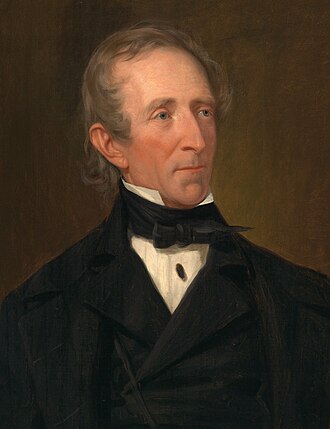 John Tyler
College Level • 1m
📜
Scholarly & Legal Citations
Exec. Order (Feb. 29, 1844), https://executiveordersarchive.org/orders/app-executive-order-500.
