Whereas it daily becomes more apparent that victory will require the fullest participation of all of the people in our war effort, and that the purchase of War Savings Bonds constitutes a direct and effective participation; and Whereas every purchaser of War Savings Bonds invests not only in the success of the Nation's common cause, but also in his own personal security and independence; and it is, therefore, to the manifest advantage of both the Government and every citizen that the sale of War Savings Bonds should be facilitated; and Whereas employers and employees in many business and industrial enterprises, as well as some Governmental activities, have developed and are maintaining, with notable success, programs that provide for the purchase of War Savings Bonds through regular, voluntary pay allotments; and it is proper that all civilian employees and officers in the executive branch of the Government should be afforded equal opportunity for voluntary participation in such systematic purchase programs: Now, Therefore , by virtue of the authority vested in me by the Constitution and the Statutes of the United States as President of the United States, it is hereby ordered as follows: 1. There is hereby established the Interdepartmental Committee for the Voluntary Pay Roll Savings Plan for the Purchase of War Savings Bonds (hereinafter referred to as the Committee). The Committee shall consist of Rear Admiral Charles Conard, Supply Corps, United States Navy, Retired, who shall serve as Chairman, and the head of each of the several departments, establishments, and agencies in the executive branch of the Government. Each member of the Committee, other than the Chairman, may designate an alternate from among the officials of his department, establishment, or agency, and such alternate may act for such member in all matters relating to the Committee. 2. The Committee shall perform the following functions and duties: a. Formulate and present to the several departments, establishments, and agencies in the executive branch of the Government a uniform plan whereby all civilian officers and employees may systematically purchase War Savings Bonds through voluntary pay allotments. b. Assist the several departments, establishments, and agencies in the adoption of said voluntary pay allotment plan and in the solution of any special problems that may develop in connection therewith. c. Act as a clearing house for the several departments, establishments, and agencies in the dissemination of such statistics and information relative to the execution of the plan as may be deemed advantageous. d. Recommend to the several departments, establishments, and agencies any improvements in the program adopted pursuant to said plan. 3. Each of the departments, establishments, and agencies in the executive branch of the Government shall institute and set in operation, as soon as may be, the plan recommended by the Committee, with such modifications as particular circumstances may render advisable. Each Committee member shall act as liaison officer between the Committee and his department, establishment, or agency with regard to said plan. FRANKLIN D ROOSEVELT The White House, April 16, 1942.
Executive Order 9135 ⚖️✨ Zone 2: Zone of Twilight Constitutional Neutral (+0.02)
📜 Art. II §2: Commander-in-Chief Supervisory Authority
Executive Order 9135—Establishing the Interdepartmental Committee for the Voluntary Pay Roll Savings Plan for the Purchase of War Savings Bonds
Executive Brief • At a Glance
⏱️ 2 min read (499 words) •
● In Effect
🎯 Primary Mandate
There is hereby established the Interdepartmental Committee for the Voluntary Pay Roll Savings Plan for the Purchase of War Savings Bonds (hereinafter referred to as the Committee).
⚖️ Constitutional Footing
⚖️✨ Zone 2: Zone of Twilight
Concurrent Authority / Congressional Silence
📜 Art. II §2: Commander-in-Chief Supervisory Authority
🏛️ Scope & Affected Sectors
Armed Forces & Military Establishments Merchants, Importers & Commercial Enterprises Executive Departments & Federal Civil Servants Private Citizens & Property Owners
Plain-English Translation & Framers' Constitutional Analysis
Early Statesman synthesis distilling legal jargon into practical meaning, statutory anchors, and structural constitutional impacts.
Signed by President Franklin D. Roosevelt on April 16, 1942, this order concerns Establishing the Interdepartmental Committee for the Voluntary Pay Roll Savings Plan for the Purchase of War Savings Bonds. There is hereby established the Interdepartmental Committee for the Voluntary Pay Roll Savings Plan for the Purchase of War Savings Bonds (hereinafter referred to as the Committee). The Committee shall consist of Rear Admiral Charles Conard, Supply Corps, United States Navy, Retired, who shall serve as Chairman, and the head of each of the several departments, establishments, and agencies in the executive branch of…
Constitutional Assessment: Scrutinized through Article II, Section 2, this action exercises the President's constitutional role as Commander in Chief. Early Framers recognized broad executive discretion in commanding military forces during conflict, provided it remains bounded by congressional declarations and respects civilian domestic courts.
Key Directives & Operative Actions
▪
There is hereby established the Interdepartmental Committee for the Voluntary Pay Roll Savings Plan for the Purchase of War Savings Bonds (hereinafter referred to as the Committee).
▪
The Committee shall consist of Rear Admiral Charles Conard, Supply Corps, United States Navy, Retired, who shall serve as Chairman, and the head of each of the several departments, establishments, and agencies in the executive branch of the Government.
▪
Each member of the Committee, other than the Chairman, may designate an alternate from among the officials of his department, establishment, or agency, and such alternate may act for such member in all matters relating to the Committee. 2.
▪
The Committee shall perform the following functions and duties: a.
Constitutional & Societal Entities Impacted
🏛️ Armed Forces & Military Establishments
🏛️ Merchants, Importers & Commercial Enterprises
🏛️ Executive Departments & Federal Civil Servants
🏛️ Private Citizens & Property Owners
🏛️ Foreign Nations & International Entities
Policy Areas & Topics
🏛️
The Framers' Constitutional Council
1787 PrismEvaluating this order against the constitutional debates of 1787 and the limits of Article II executive power.
⚖️✨ Zone 2 (Zone of Twilight)
§
"When the President acts in absence of either a congressional grant or denial of authority, he can only rely upon his own independent powers, but there is a zone of twilight in which he and Congress may have concurrent authority."
— Justice Robert H. Jackson, Youngstown Sheet & Tube Co. v. Sawyer (1952) Concurrent Authority / Congressional Silence
JM
James Madison
Separation of Powers & Legislative Primacy
"Power is of an encroaching nature, and it ought to be effectually restrained from passing the limits assigned to it." — Federalist No. 48 (1788)
Madison would view this order with watchful scrutiny. Operating in the 'Zone of Twilight' where Congress is silent, each such directive establishes an administrative precedent that steadily expands the executive perimeter at the expense of legislative primacy.
Madisonian Stance: Vigilant / Cautionary
AH
Alexander Hamilton
The Energetic Executive & Unified Command
"The direction of war implies the direction of the common strength; and the power of directing and employing the common strength must be under the direction of the single hand of the Executive." — Federalist No. 74 (1788)
Hamilton would forcefully champion executive discretion here. For foreign entanglements, commerce defense, and national security, deliberative assemblies are too slow and faction-ridden. A unified, energetic Executive exercising swift command is precisely what the Philadelphia Convention intended for national preservation.
Hamiltonian Stance: Strong Prerogative Support
GM
George Mason
Bill of Rights, Due Process & 10th Amendment
"The president will be surrounded by flatterers and sycophants... and the great powers of the executive will gradually absorb the liberties of the people." — Cato IV (Anti-Federalist, 1787)
The Anti-Federalist prism advises continuous democratic vigilance. Even routine administrative directives aggregate centralized federal power away from town halls and state assemblies toward a distant executive apparatus.
Anti-Federalist Stance: Eternal Vigilance Required
📐
Five Measurable "Constitutional Friction" Dimensions
An objective audit measuring potential separation-of-powers tension against the United States Constitution and established Supreme Court doctrine.
⚖️ Discretionary Twilight Zone
41 / 100 friction index
Dimension 1 • Art. I, §1 & §8
Low Friction
Legislative Encroachment & Purse
Operates within delegated statutory execution without modifying legislative appropriations or taxing powers.
Benchmark: Power of the purse, taxes/tariffs, and rule of law reserved to Congress.
Dimension 2 • Art. II, §1 & §3
Low Friction
Executive Scope & Faithfulness
Exercises standard supervisory executive authority to faithfully execute existing statutes.
Benchmark: Faithfully execute laws enacted by Congress vs. unilateral decree.
Dimension 3 • 10th Amendment
High Friction
Federalism & State Sovereignty
Creates friction with the Tenth Amendment by conditioning state grants, mandating local compliance, or preempting state police powers.
Benchmark: Police powers and un-delegated responsibilities reserved to the States.
Dimension 4 • 5th & 14th Amendments
Moderate Friction
Due Process & Individual Rights
Applies regulatory or compliance standards to private contractors or commercial entities.
Benchmark: Protection of private property, contracts, liberty, and procedural justice.
Dimension 5 • Separation of Powers
Moderate Friction
Youngstown Jacksonian Tier
The order relies on inherent Article II executive discretion, civil service management, or foreign diplomacy where Congress has neither expressly approved nor prohibited action.
Benchmark: Concurrent Authority / Congressional Silence
⚖️
Audit Synthesis
This order operates within Justice Jackson’s Zone of Twilight, resting upon concurrent presidential authority or congressional silence.
Weighted composite: Art. I (25%), Art. II (25%), Federalism (15%), Due Process (15%), Youngstown (20%).
ℹ️
How to read these dimensions: Executive power expands whenever an administration acts without explicit statutory authorization from Congress (Article I), touches upon police powers historically reserved to the states (Tenth Amendment), or limits private rights and property without judicial process. A low friction score indicates strict concordance with enacted law; a high friction score highlights orders testing the limits of presidential discretion.
Total Words
499
3,224 characters
Estimated Read Time
2 min
@ 200 words / min
Flesch-Kincaid
21.7
Post-Graduate Legal
Text size:
🔗
Referenced By Later Executive Orders (1)
Subsequent presidents who cited, amended, continued, or revoked this directive in later orders.
Related Executive Orders
Other executive actions signed by Franklin D. Roosevelt around this period.
EO 9137 Apr 16, 1942
⚖️✨ Zone 2 (Zone of Twilight) Constitutional Neutral
Executive Order 9137—Withdrawing Public Lands for Use of the War Department for Flood Control Purposes
📜 Art. II §2: Commander-in-Chief Supervisory Authority
Subject to valid existing rights and to withdrawals and classifications for power purposes, the following-described public lands in Arkansas be, and they are hereby, withdrawn from all forms of appropriation tinder the public-land laws, including the mining laws, for use in…
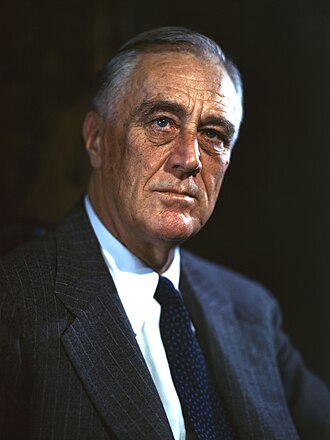 Franklin D. Roosevelt
Grade 6 • 1m
EO 9136 Apr 16, 1942
⚖️✨ Zone 2 (Zone of Twilight) Constitutional Neutral
Executive Order 9136—Modifying Executive Orders No. 1919½ of April 21, 1914, No. 2728 of October 8, 1917, and No. 3672 of May 8, 1922, and Reserving Public Lands for the Use of the War Department
📜 Art. II §2: Commander-in-Chief Supervisory Authority
Executive Orders No. 1919 ½ of April 21, 1914, No. 2728 of October 8, 1917, and No. 3672 of May 8, 1922, withdrawing certain lands for townsite purposes, are hereby modified to the extent necessary to permit the reservation described in Section 2 of this order. Section 2.
Franklin D. Roosevelt High School • 1m
EO 9138 Apr 17, 1942
⚖️✨ Zone 2 (Zone of Twilight) Constitutional Neutral
Executive Order 9138—Providing Further for the Administration of the Requisitioning of Property Required for the Prosecution of the War
📜 Art. II §2: Commander-in-Chief Supervisory Authority
In addition to the authority conferred upon the Chairman of the War Production Board and the heads of certain departments and agencies by Executive Order No. 8942 of November 19, 1941, and Executive Order No. 9040 of January 24, 1942, such officials shall exercise in the manner…
Franklin D. Roosevelt High School • 1m
EO 9134 Apr 15, 1942
⚖️✨ Zone 2 (Zone of Twilight) Constitutional Neutral
Executive Order 9134—Amendment of Executive Order No. 8757 of May 20, 1941 Establishing the Office of Civilian Defense
📜 Art. II §2: Commander-in-Chief Supervisory Authority
There is established within the Office for Emergency Management of the Executive Office of the President the Office of Civilian Defense, at the head of which shall be a Director appointed by the President.
Franklin D. Roosevelt Post-Graduate Legal • 4m
EO 9141 Apr 18, 1942
⚖️✨ Zone 2 (Zone of Twilight) Constitutional Neutral
Executive Order 9141—Possession and Operation of Plants of Brewster Aeronautical Corporation
📜 Art. II §2: Commander-in-Chief Supervisory Authority
I, Franklin D. Roosevelt , pursuant to the powers vested in me by the Constitution and laws of the United States, as President of the United States and Commander-in-Chief of the Army and Navy of the United States, hereby authorize and direct the Secretary of the Navy…
Franklin D. Roosevelt Post-Graduate Legal • 2m
EO 9139 Apr 18, 1942
⚖️✨ Zone 2 (Zone of Twilight) Constitutional Neutral
Executive Order 9139—Establishing the War Manpower Commission in the Executive Office of the President and Transferring and Coordinating Certain Functions to Facilitate the Mobilization and Utilization of Manpower
📜 Art. II §2: Commander-in-Chief Supervisory Authority
There is established within the Office for Emergency Management of the Executive Office of the President a War Manpower Commission, hereinafter referred to as the Commission.
Franklin D. Roosevelt Post-Graduate Legal • 6m
📜
Scholarly & Legal Citations
Exec. Order No. 9135 (Apr. 16, 1942), https://executiveordersarchive.org/orders/app-executive-order-9135-establishing-the-interdepartmental-committee-for-the-voluntary-pay.
