By virtue of the authority vested in me by Title I of the First War Powers Act, 1941 (Public Law 354, 77th Congress), and as President of the United States and Commander-in-Chief of the Army and Navy, and by reason of the strategic importance of the Territory of Alaska in the present war, and for the purposes of (a) promoting the safety of the citizens of the Territory of Alaska and of the entire North American continent, (b) securing the more effective exercise and more efficient administration by the President of his powers as Commander-in-Chief of the Army and Navy and as President, and (c) facilitating coordination of Federal civil policies, plans, and activities in the Territory of Alaska with the policies, plans, and activities of the military authorities responsible for the defense of the Territory, it is hereby ordered as follows: 1. The ex-officio Commissioners for Alaska designated by the Secretaries of the Interior, Agriculture, and Commerce under the Act of February 10, 1927 (44 Stat. 1068, 5 U.S.C. 119), an official to be designated by the Federal Security Administrator, and an official to be designated by the Federal Works Administrator, shall be invested by such respective Secretaries and Administrators with authority and responsibility as their representatives for making decisions requisite to the prompt performance of the duties of such departments and agencies, and to meeting emergencies requiring any such department or agency to furnish special services, in the Territory of Alaska, hereafter called Alaska. The said Commissioners and officials shall, for the purposes of this order, be special representatives in Alaska of their respective departments and agencies. 2. The special representatives provided for in section 1 hereof, together with the Governor of Alaska, a person to be designated by the Attorney General of the United States, and a resident of Alaska to be elected by such special representatives, Governor, and person, shall constitute an Alaska War Council, hereafter called the Council, with organization, functions, and duties as follows: (a) The Governor of Alaska shall be the Chairman of the Council. The Council shall elect one of its members to serve as Vice-Chairman of the Council. (b) The Council shall meet at the call of the Chairman or, when the Chairman is unable to act, at the call of the Vice-Chairman or, as hereinafter provided, at the request of the military authorities. Meetings shall be held as the demands of the war emergency may require, but not less often than bi-monthly. (c) It shall be the duty of the Council, and of the said special representatives with regard to programs and progress in their respective fields of activity, to maintain close liaison with the military authorities in Alaska to the end that for the duration of the war the conduct of Federal civil activities shall be brought into closest possible conformity with military requirements. (d) The Council shall consult from time to time with the Alaska representatives of the National Resources Planning Board. (e) The Council shall make such recommendations to the military and other Federal authorities as it deems desirable relative to coordination of Federal civil activities with the military program and relative to the safety and security of the civilian population of Alaska. Any such recommendations made to the military authorities shall be submitted through the appropriate liaison officers hereinafter provided for. 3. The Governor of Alaska, as Chairman of the Council, shall keep the President informed with regard to major steps proposed or adopted for the protection of the civilian population of Alaska: Provided , That confidential or secret information concerning military operations shall be transmitted through military channels only. 4. In connection with the activities of the Army and Navy forces in Alaska, the commanding officers of such forces and other military authorities shall, to the fullest extent possible, give consideration to civilian needs and problems arising from the war situation in Alaska. To this end the Department of War and the Department of the Navy shall each designate a responsible liaison officer who shall meet with the Council and to whom the Council and said special representatives shall have ready access. The said liaison officers, acting either jointly or singly, are authorized to request a meeting of the Council, whereupon it shall be convened. 5. The heads of civil Federal departments, agencies, independent establishments, and Government-owned corporations conducting activities in Alaska, or their special representatives designated in accordance with this order, shall conform with such requests as the Secretary of War may deem necessary for the effective utilization in the prosecution of the war of the services, personnel, equipment, and facilities of any such agency, independent establishment, or corporation, or of any bureau, office or other administrative unit of any such department. The Secretary of War, in the formulation of any such requests, shall coordinate with the Secretary of the Navy with regard to all matters of interest to the Department of the Navy. 6. This order shall become effective as of the date hereof and shall continue in force and effect so long as Title I of the First War Powers Act, 1941, remains in force. FRANKLIN D ROOSEVELT The White House, June 11, 1942.
Executive Order 9181 ⚖️✨ Zone 2: Zone of Twilight Constitutional Neutral (+0.02)
📜 Art. II §2: Commander-in-Chief Supervisory Authority
Executive Order 9181—Administration of the Federal Government Services in Alaska
Executive Brief • At a Glance
⏱️ 4 min read (862 words) •
● In Effect
🎯 Primary Mandate
The ex-officio Commissioners for Alaska designated by the Secretaries of the Interior, Agriculture, and Commerce under the Act of February 10, 1927 (44 Stat. 1068, 5 U.S.C. 119), an official to be designated by the Federal Security Administrator, and an official to be designated by the Federal Works Administrator, shall be invested by such respective Secretaries and Administrators with authority and responsibility as their representatives for making decisions requisite to the prompt performance of the duties of such departments and agencies, and to meeting emergencies requiring any such department or agency to furnish special services, in the Territory of Alaska, hereafter called Alaska.
⚖️ Constitutional Footing
⚖️✨ Zone 2: Zone of Twilight
Concurrent Authority / Congressional Silence
📜 Art. II §2: Commander-in-Chief Supervisory Authority
🏛️ Scope & Affected Sectors
Armed Forces & Military Establishments Merchants, Importers & Commercial Enterprises Sovereign State Governments & Localities Executive Departments & Federal Civil Servants
Plain-English Translation & Framers' Constitutional Analysis
Early Statesman synthesis distilling legal jargon into practical meaning, statutory anchors, and structural constitutional impacts.
Signed by President Franklin D. Roosevelt on June 11, 1942, this order concerns Administration of the Federal Government Services in Alaska. The ex-officio Commissioners for Alaska designated by the Secretaries of the Interior, Agriculture, and Commerce under the Act of February 10, 1927 (44 Stat. 1068, 5 U.S.C. 119), an official to be designated by the Federal Security Administrator, and an official to be designated by the Federal Works Administrator, shall be invested by such respective Secretaries and Administrators with authority and responsibility…
Constitutional Assessment: Scrutinized through Article II, Section 2, this action exercises the President's constitutional role as Commander in Chief. Early Framers recognized broad executive discretion in commanding military forces during conflict, provided it remains bounded by congressional declarations and respects civilian domestic courts.
Key Directives & Operative Actions
▪
The ex-officio Commissioners for Alaska designated by the Secretaries of the Interior, Agriculture, and Commerce under the Act of February 10, 1927 (44 Stat. 1068, 5 U.S.C. 119), an official to be designated by the Federal Security Administrator, and an official to be designated by the Federal Works Administrator, shall be invested by such respective Secretaries and Administrators with authority and responsibility as their representatives for making decisions requisite to the prompt performance of the duties of such departments and agencies, and to meeting emergencies requiring any such department or agency to furnish special services, in the Territory of Alaska, hereafter called Alaska.
▪
The said Commissioners and officials shall, for the purposes of this order, be special representatives in Alaska of their respective departments and agencies. 2.
▪
The special representatives provided for in section 1 hereof, together with the Governor of Alaska, a person to be designated by the Attorney General of the United States, and a resident of Alaska to be elected by such special representatives, Governor, and person, shall constitute an Alaska War Council, hereafter called the Council, with organization, functions, and duties as follows: (a) The Governor of Alaska shall be the Chairman of the Council.
▪
The Council shall elect one of its members to serve as Vice-Chairman of the Council.
Constitutional & Societal Entities Impacted
🏛️ Armed Forces & Military Establishments
🏛️ Merchants, Importers & Commercial Enterprises
🏛️ Sovereign State Governments & Localities
🏛️ Executive Departments & Federal Civil Servants
🏛️ Private Citizens & Property Owners
Policy Areas & Topics
🏛️
The Framers' Constitutional Council
1787 PrismEvaluating this order against the constitutional debates of 1787 and the limits of Article II executive power.
⚖️✨ Zone 2 (Zone of Twilight)
§
"When the President acts in absence of either a congressional grant or denial of authority, he can only rely upon his own independent powers, but there is a zone of twilight in which he and Congress may have concurrent authority."
— Justice Robert H. Jackson, Youngstown Sheet & Tube Co. v. Sawyer (1952) Concurrent Authority / Congressional Silence
JM
James Madison
Separation of Powers & Legislative Primacy
"Power is of an encroaching nature, and it ought to be effectually restrained from passing the limits assigned to it." — Federalist No. 48 (1788)
Madison would view this order with watchful scrutiny. Operating in the 'Zone of Twilight' where Congress is silent, each such directive establishes an administrative precedent that steadily expands the executive perimeter at the expense of legislative primacy.
Madisonian Stance: Vigilant / Cautionary
AH
Alexander Hamilton
The Energetic Executive & Unified Command
"The direction of war implies the direction of the common strength; and the power of directing and employing the common strength must be under the direction of the single hand of the Executive." — Federalist No. 74 (1788)
Hamilton would forcefully champion executive discretion here. For foreign entanglements, commerce defense, and national security, deliberative assemblies are too slow and faction-ridden. A unified, energetic Executive exercising swift command is precisely what the Philadelphia Convention intended for national preservation.
Hamiltonian Stance: Strong Prerogative Support
GM
George Mason
Bill of Rights, Due Process & 10th Amendment
"The president will be surrounded by flatterers and sycophants... and the great powers of the executive will gradually absorb the liberties of the people." — Cato IV (Anti-Federalist, 1787)
The Anti-Federalist prism advises continuous democratic vigilance. Even routine administrative directives aggregate centralized federal power away from town halls and state assemblies toward a distant executive apparatus.
Anti-Federalist Stance: Eternal Vigilance Required
📐
Five Measurable "Constitutional Friction" Dimensions
An objective audit measuring potential separation-of-powers tension against the United States Constitution and established Supreme Court doctrine.
⚖️ Discretionary Twilight Zone
48 / 100 friction index
Dimension 1 • Art. I, §1 & §8
Moderate Friction
Legislative Encroachment & Purse
Administers commerce or fiscal programs requiring ongoing statutory delegation and legislative oversight.
Benchmark: Power of the purse, taxes/tariffs, and rule of law reserved to Congress.
Dimension 2 • Art. II, §1 & §3
Low Friction
Executive Scope & Faithfulness
Exercises standard supervisory executive authority to faithfully execute existing statutes.
Benchmark: Faithfully execute laws enacted by Congress vs. unilateral decree.
Dimension 3 • 10th Amendment
High Friction
Federalism & State Sovereignty
Creates friction with the Tenth Amendment by conditioning state grants, mandating local compliance, or preempting state police powers.
Benchmark: Police powers and un-delegated responsibilities reserved to the States.
Dimension 4 • 5th & 14th Amendments
Moderate Friction
Due Process & Individual Rights
Applies regulatory or compliance standards to private contractors or commercial entities.
Benchmark: Protection of private property, contracts, liberty, and procedural justice.
Dimension 5 • Separation of Powers
Moderate Friction
Youngstown Jacksonian Tier
The order relies on inherent Article II executive discretion, civil service management, or foreign diplomacy where Congress has neither expressly approved nor prohibited action.
Benchmark: Concurrent Authority / Congressional Silence
⚖️
Audit Synthesis
This order operates within Justice Jackson’s Zone of Twilight, resting upon concurrent presidential authority or congressional silence.
Weighted composite: Art. I (25%), Art. II (25%), Federalism (15%), Due Process (15%), Youngstown (20%).
ℹ️
How to read these dimensions: Executive power expands whenever an administration acts without explicit statutory authorization from Congress (Article I), touches upon police powers historically reserved to the states (Tenth Amendment), or limits private rights and property without judicial process. A low friction score indicates strict concordance with enacted law; a high friction score highlights orders testing the limits of presidential discretion.
Total Words
862
5,422 characters
Estimated Read Time
4 min
@ 200 words / min
Flesch-Kincaid
21.9
Post-Graduate Legal
Text size:
Related Executive Orders
Other executive actions signed by Franklin D. Roosevelt around this period.
EO 9182 Jun 13, 1942
⚖️⚠️ Zone 3 (Lowest Ebb) Friction (-0.44)
Executive Order 9182—Consolidating Certain War Information Functions Into an Office of War Information
📜 Art. II §2: Commander-in-Chief / War Prerogative Tension
The following agencies, powers, and duties are transferred and consolidated into an Office of War Information which is hereby established within the Office for Emergency Management in the Executive Office of the President: (a) The Office of Facts and Figures and its powers and…
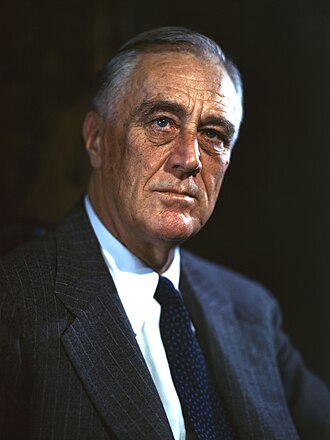 Franklin D. Roosevelt
Post-Graduate Legal • 7m
EO 9183 Jun 15, 1942
⚖️✨ Zone 2 (Zone of Twilight) Constitutional Neutral
Executive Order 9183—Changing the Name of the Defense Communications Board To Board of War Communications
📜 Art. II §2: Commander-in-Chief Supervisory Authority
The name of the Defense Communications Board, established by Executive Order No. 8546 of September 24, 1940, is changed to Board of War Communications. 2.
Franklin D. Roosevelt High School • 1m
EO 9180 Jun 5, 1942
⚖️✨ Zone 2 (Zone of Twilight) Constitutional Neutral
Executive Order 9180—Authorizing the Secretary of the Interior To Enter Into Contracts for the Disposal of Yucca Growing on the Public Domain
📜 Art. II §2: Commander-in-Chief Supervisory Authority
The Secretary of the Interior is hereby authorized to enter into contracts, through the Commissioner of the General Land Office, for the disposal of yucca growing on the public domain, under such terms and conditions as he may deem proper whenever he finds that the materials or…
Franklin D. Roosevelt Post-Graduate Legal • 1m
EO 9179 Jun 5, 1942
⚖️✨ Zone 2 (Zone of Twilight) Constitutional Neutral
Executive Order 9179—Authorizing the Commissioner of Public Roads, Federal Works Agency, To Acquire and Dispose of Property
📜 Art. II §2: Commander-in-Chief Supervisory Authority
The Commissioner of Public Roads, Federal Works Agency, or any officer of the Public Roads Administration acting in the absence or disability of the Commissioner, is hereby authorized to exercise the authority contained in the said Title II of the Second War Powers Act, 1942…
Franklin D. Roosevelt Post-Graduate Legal • 1m
EO 9184 Jun 22, 1942
⚖️✨ Zone 2 (Zone of Twilight) Constitutional Neutral
Executive Order 9184—Amending Executive Order No. 9139 of April 18, 1942, To Provide for the Appointment of Additional Members to the War Manpower Commission
📜 Art. II §2: Commander-in-Chief Supervisory Authority
Executive Order No. 9139 of April 18, 1942, establishing the War Manpower Commission in the Executive Office of the President, be, and it is hereby, amended to include in the membership of the said Commission a representative of the National Housing Agency and a joint…
Franklin D. Roosevelt Post-Graduate Legal • 1m
EO 9185 Jun 23, 1942
⚖️✨ Zone 2 (Zone of Twilight) Constitutional Neutral
Executive Order 9185—Establishing the Susquehanna National Wildlife Refuge
📜 Art. II §2: Commander-in-Chief Supervisory Authority
All the hereinafter-described lands and waters, including all of Shad Battery, or Edmondsons Island, owned or controlled by the United States and situated at the mouth of the Susquehanna River, in and at the head of Chesapeake Bay, in Harford and Cecil Counties, Maryland, be…
Franklin D. Roosevelt High School • 2m
📜
Scholarly & Legal Citations
Exec. Order No. 9181 (June 11, 1942), https://executiveordersarchive.org/orders/app-executive-order-9181-administration-the-federal-government-services-alaska.
