Whereas it is the policy of this Government to take all measures within its power to rescue the victims of enemy oppression who are in imminent danger of death and otherwise to afford such victims all possible relief and assistance consistent with the successful prosecution of the war; Now, Therefore , by virtue of the authority vested in me by the Constitution and the statutes of the United States, as President of the United States and as Commander in Chief of the Army and Navy, and in order to effectuate with all possible speed the rescue and relief of such victims of enemy oppression, it is hereby ordered as follows: 1. There is established in the Executive Office of the President a War Refugee Board (hereinafter referred to as the Board). The Board shall consist of the Secretary of State, the Secretary of the Treasury, and the Secretary of War. The Board may request the heads of other agencies or departments to participate in its deliberations whenever matters specially affecting such agencies or departments are under consideration. 2. The Board shall be charged with the responsibility for seeing that the policy of the Government, as stated in the Preamble, is carried out. The functions of the Board shall include without limitation the development of plans and programs and the inauguration of effective measures for (a) the rescue, transportation, maintenance, and relief of the victims of enemy oppression, and (b) the establishment of havens of temporary refuge for such victims. To this end the Board, through appropriate channels, shall take the necessary steps to enlist the cooperation of foreign Governments and obtain their participation in the execution of such plans and programs. 3. It shall be the duty of the State, Treasury, and War Departments, within their respective spheres, to execute at the request of the Board, the plans and programs so developed and the measures so inaugurated. It shall be the duty of the heads of all agencies and departments to supply or obtain for the Board such information and to extend to the Board such supplies, shipping, and other specified assistance and facilities as the Board may require in carrying out the provisions of this Order. The State Department shall appoint special attaches with diplomatic status, on the recommendation of the Board, to be stationed abroad in places where it is likely that assistance can be rendered to war refugees, the duties and responsibilities of such attaches to be defined by the Board in consultation with the State Department. 4. The Board and the State, Treasury, and War Departments are authorized to accept the services or contributions of any private persons, private organizations, State agencies, or agencies of foreign governments in carrying out the purposes of this Order. The Board shall cooperate with all existing and future international organizations concerned with the problems of refugee rescue, maintenance, transportation, relief, rehabilitation, and resettlement. 5. To the extent possible the Board shall utilize the personnel, supplies, facilities, and services of the State, Treasury, and War Departments. In addition the Board, within the limits of funds which may be made available, may employ necessary personnel without regard for the Civil Service laws and regulations and the Classification Act of 1923, as amended, and make provisions for supplies, facilities, and services necessary to discharge its responsibilities. The Board shall appoint an Executive Director who shall serve as its principal executive officer. It shall be the duty of the Executive Director to arrange for the prompt execution of the plans and programs developed and the measures inaugurated by the Board, to supervise the activities of the special attaches, and to submit frequent reports to the Board on the steps taken for the rescue and relief of war refugees. 6. The Board shall be directly responsible to the President in carrying out the policy of this Government, as stated in the Preamble, and the Board shall report to him at frequent intervals concerning the steps taken for the rescue and relief of war refugees and shall make such recommendations as the Board may deem appropriate for further action to overcome any difficulties encountered in the rescue and relief of war refugees. FRANKLIN D ROOSEVELT The White House, January 22, 1944.
Executive Order 9417 🏛️✅ Zone 1: Maximum Authority Constitutional Fidelity (+0.23)
📜 Art. II §2: Commander-in-Chief Supervisory Authority
Executive Order 9417—Establishing a War Refugee Board
Executive Brief • At a Glance
⏱️ 4 min read (705 words) •
● In Effect
🎯 Primary Mandate
There is established in the Executive Office of the President a War Refugee Board (hereinafter referred to as the Board).
⚖️ Constitutional Footing
🏛️✅ Zone 1: Maximum Authority
Express or Implied Congressional Authorization
📜 Art. II §2: Commander-in-Chief Supervisory Authority
🏛️ Scope & Affected Sectors
Armed Forces & Military Establishments Merchants, Importers & Commercial Enterprises Sovereign State Governments & Localities Executive Departments & Federal Civil Servants
Plain-English Translation & Framers' Constitutional Analysis
Early Statesman synthesis distilling legal jargon into practical meaning, statutory anchors, and structural constitutional impacts.
Signed by President Franklin D. Roosevelt on January 22, 1944, this order concerns Establishing a War Refugee Board. There is established in the Executive Office of the President a War Refugee Board (hereinafter referred to as the Board). The Board shall consist of the Secretary of State, the Secretary of the Treasury, and the Secretary of War.
Constitutional Assessment: Scrutinized through Article II, Section 2, this action exercises the President's constitutional role as Commander in Chief. Early Framers recognized broad executive discretion in commanding military forces during conflict, provided it remains bounded by congressional declarations and respects civilian domestic courts.
Key Directives & Operative Actions
▪
There is established in the Executive Office of the President a War Refugee Board (hereinafter referred to as the Board).
▪
The Board shall consist of the Secretary of State, the Secretary of the Treasury, and the Secretary of War.
▪
The Board shall be charged with the responsibility for seeing that the policy of the Government, as stated in the Preamble, is carried out.
▪
The functions of the Board shall include without limitation the development of plans and programs and the inauguration of effective measures for (a) the rescue, transportation, maintenance, and relief of the victims of enemy oppression, and (b) the establishment of havens of temporary refuge for such victims.
Constitutional & Societal Entities Impacted
🏛️ Armed Forces & Military Establishments
🏛️ Merchants, Importers & Commercial Enterprises
🏛️ Sovereign State Governments & Localities
🏛️ Executive Departments & Federal Civil Servants
🏛️ Foreign Nations & International Entities
Policy Areas & Topics
🏛️
The Framers' Constitutional Council
1787 PrismEvaluating this order against the constitutional debates of 1787 and the limits of Article II executive power.
🏛️✅ Zone 1 (Maximum Authority)
§
"When the President acts pursuant to an express or implied authorization of Congress, his authority is at its maximum, for it includes all that he possesses in his own right plus all that Congress can delegate."
— Justice Robert H. Jackson, Youngstown Sheet & Tube Co. v. Sawyer (1952) Express or Implied Congressional Authorization
JM
James Madison
Separation of Powers & Legislative Primacy
"The constitutional magistracy was designed not to invent policy, but to be the faithful instrument of the laws passed by the people's representatives." — Speech in the First Congress (1789)
Madison would approve the structural posture of this order. The President acts strictly in subordination to statutory authority granted under Article II, Section 3 ("take Care that the Laws be faithfully executed"). The checks and balances hold firm because the policy origin remains with the legislature.
Madisonian Stance: Concurring (Statutory)
AH
Alexander Hamilton
The Energetic Executive & Unified Command
"The direction of war implies the direction of the common strength; and the power of directing and employing the common strength must be under the direction of the single hand of the Executive." — Federalist No. 74 (1788)
Hamilton would forcefully champion executive discretion here. For foreign entanglements, commerce defense, and national security, deliberative assemblies are too slow and faction-ridden. A unified, energetic Executive exercising swift command is precisely what the Philadelphia Convention intended for national preservation.
Hamiltonian Stance: Strong Prerogative Support
GM
George Mason
Bill of Rights, Due Process & 10th Amendment
"The president will be surrounded by flatterers and sycophants... and the great powers of the executive will gradually absorb the liberties of the people." — Cato IV (Anti-Federalist, 1787)
The Anti-Federalist prism advises continuous democratic vigilance. Even routine administrative directives aggregate centralized federal power away from town halls and state assemblies toward a distant executive apparatus.
Anti-Federalist Stance: Eternal Vigilance Required
📐
Five Measurable "Constitutional Friction" Dimensions
An objective audit measuring potential separation-of-powers tension against the United States Constitution and established Supreme Court doctrine.
⚖️ Discretionary Twilight Zone
51 / 100 friction index
Dimension 1 • Art. I, §1 & §8
High Friction
Legislative Encroachment & Purse
Touches upon core congressional prerogatives: raises appropriations reallocation, tariff imposition, or statutory preemption questions.
Benchmark: Power of the purse, taxes/tariffs, and rule of law reserved to Congress.
Dimension 2 • Art. II, §1 & §3
Moderate Friction
Executive Scope & Faithfulness
Directs internal executive branch machinery, agency workflows, and federal personnel.
Benchmark: Faithfully execute laws enacted by Congress vs. unilateral decree.
Dimension 3 • 10th Amendment
High Friction
Federalism & State Sovereignty
Creates friction with the Tenth Amendment by conditioning state grants, mandating local compliance, or preempting state police powers.
Benchmark: Police powers and un-delegated responsibilities reserved to the States.
Dimension 4 • 5th & 14th Amendments
Low Friction
Due Process & Individual Rights
Focuses on internal governmental operations with no direct impairment of private rights or property.
Benchmark: Protection of private property, contracts, liberty, and procedural justice.
Dimension 5 • Separation of Powers
Low Friction
Youngstown Jacksonian Tier
The President operates strictly as the constitutional Chief Executive, carrying out policy established by Congress with strong statutory backing.
Benchmark: Express or Implied Congressional Authorization
⚖️
Audit Synthesis
This order operates within Justice Jackson’s Zone of Twilight, resting upon concurrent presidential authority or congressional silence.
Weighted composite: Art. I (25%), Art. II (25%), Federalism (15%), Due Process (15%), Youngstown (20%).
ℹ️
How to read these dimensions: Executive power expands whenever an administration acts without explicit statutory authorization from Congress (Article I), touches upon police powers historically reserved to the states (Tenth Amendment), or limits private rights and property without judicial process. A low friction score indicates strict concordance with enacted law; a high friction score highlights orders testing the limits of presidential discretion.
Total Words
705
4,371 characters
Estimated Read Time
4 min
@ 200 words / min
Flesch-Kincaid
20
Post-Graduate Legal
Text size:
🔗
Referenced By Later Executive Orders (1)
Subsequent presidents who cited, amended, continued, or revoked this directive in later orders.
Harry S Truman • 1945-09-14
Related Executive Orders
Other executive actions signed by Franklin D. Roosevelt around this period.
EO 9416 Jan 21, 1944
⚖️✨ Zone 2 (Zone of Twilight) Constitutional Neutral
Executive Order 9416—Authorizing the Secretary of the Navy to Take Possession of and Operate the Plants of York Safe & Lock Company, York County, Pennsylvania
📜 Art. II §2: Commander-in-Chief Supervisory Authority
I, Franklin D. Roosevelt , pursuant to the powers vested in me by the Constitution and laws of the United States, including Section 9 of the Selective Training and Service Act of 1940, as amended, as President of the United States and Commander in Chief of the Army and Navy of…
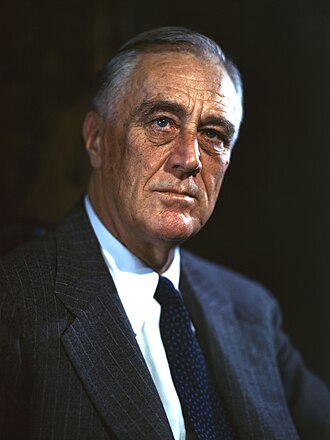 Franklin D. Roosevelt
Post-Graduate Legal • 2m
EO 9415 Jan 20, 1944
⚖️⚠️ Zone 3 (Lowest Ebb) Friction (-0.19)
Executive Order 9415—Transfer of Certain Personnel From the Coast and Geodetic Survey to the War Department
📜 Art. II §2: Commander-in-Chief / War Prerogative Tension
The following-named commissioned officers are hereby transferred from the Coast and Geodetic Survey to the service and jurisdiction of the War Department: Lieutenant Commander Charles A. Schanck Lieutenant Chester J. Beyma Lieutenant Charles F. Chenworth Lieutenant William F.…
Franklin D. Roosevelt High School • 1m
EO 9418 Jan 29, 1944
⚖️✨ Zone 2 (Zone of Twilight) Constitutional Neutral
Executive Order 9418—Authorizing the War Food Administration to Place Orders With Other Agencies for Materials or Services to Be Obtained by Contract or Otherwise
📜 Art. II §2: Commander-in-Chief Supervisory Authority
The functions, powers, and duties, with respect to placing orders for materials, supplies, equipment, work, or services, of any kind that any requisitioned Federal agency may be in a position to supply, or to render or to obtain by contract, which are vested in the War…
Franklin D. Roosevelt College Level • 1m
EO 9414 Jan 13, 1944
⚖️✨ Zone 2 (Zone of Twilight) Constitutional Neutral
Executive Order 9414—Regulations Relating to Annual and Sick Leave of Government Employees
📜 Art. II §2: Commander-in-Chief Supervisory Authority
I hereby prescribe the following regulations governing the granting of Annual and Sick leave to civilian officers and employees of the United States, the District of Columbia, and all corporations included within the provisions of the said acts of March 14, 1936, except as…
Franklin D. Roosevelt College Level • 16m
EO 9419 Feb 4, 1944
⚖️✨ Zone 2 (Zone of Twilight) Constitutional Neutral
Executive Order 9419—Bronze Star Medal
📜 Art. II §2: Commander-in-Chief Supervisory Authority
There is hereby established the Bronze Star Medal, with accompanying ribbons and appurtenances, for award to any person who, while serving in any capacity in or with the Army, Navy, Marine Corps, or Coast Guard of the United States on or after December 7, 1941, distinguishes…
Franklin D. Roosevelt Post-Graduate Legal • 1m
EO 9420 Feb 7, 1944
⚖️✨ Zone 2 (Zone of Twilight) Constitutional Neutral
Executive Order 9420—Authorizing the Secretary of War to Take Possession of and Operate the Plants and Facilities of the Arkwright Corporation, Berkshire Fine Spinning Associates, Inc., Border City Manufacturing Company, Bourne Mills, Howard Arthur Mills, Richard Borden Manufacturing Company, and Sagamore Manufacturing Company, in and About Fall River, Massachusetts
📜 Art. II §2: Commander-in-Chief Supervisory Authority
The Secretary of War is hereby authorized to take possession of the plants and facilities of the companies hereinafter named, and to the extent deemed desirable by him of any additional textile plants, facilities or installations situated in and about Fall River, Massachusetts…
Franklin D. Roosevelt Post-Graduate Legal • 3m
📜
Scholarly & Legal Citations
Exec. Order No. 9417 (Jan. 22, 1944), https://executiveordersarchive.org/orders/app-executive-order-9417-establishing-war-refugee-board.
