Andrew Jackson is no more. He departed this life on Sunday, the 8th instant, full of days and full of honors. His country deplores his loss, and will ever cherish his memory. Whilst a nation mourns it is proper that business should be suspended, at least for one day, in the Executive Departments, as a tribute of respect to the illustrious dead. I accordingly direct that the Departments of State, the Treasury, War, the Navy, the Post-Office, the office of the Attorney-General, and the Executive Mansion be instantly put into mourning, and that they be closed during the whole day tomorrow. JAMES K. POLK. GENERAL ORDERS, NO. 27. WAR DEPARTMENT, ADJUTANT-GENERAL'S OFFICE, Washington, June 16, 1845 . The following general order of the President, received through the War Department, announces to the Army the death of the illustrious ex-President, General Andrew Jackson: General Order. WASHINGTON, June 16, 1845. The President of the United States with heartfelt sorrow announces to the Army, the Navy, and the Marine Corps the death of Andrew Jackson. On the evening of Sunday, the 8th day of June, about 6 o'clock, he resigned his spirit to his Heavenly Father. The nation, while it learns with grief the death of its most illustrious citizen, finds solace in contemplating his venerable character and services. The Valley of the Mississippi beheld in him the bravest and wisest and most fortunate of its defenders; the country raised him to the highest trusts in military and in civil life with a confidence that never abated and an affection that followed him in undiminished vigor to retirement, watched over his latest hours, and pays its tribute at his grave. Wherever his lot was east he appeared among those around him first in natural endowments and resources, not less than first in authority and station. The power of his mind impressed itself on the policy of his country, and still lives, and will live forever in the memory of its people. Child of a forest region and a settler of the wilderness, his was a genius which, as it came to the guidance of affairs, instinctively attached itself to general principles, and inspired by the truth which his own heart revealed to him in singleness and simplicity, he found always a response in the breast of his countrymen. Crowned with glory in war, in his whole career as a statesman he showed himself the friend and lover of peace. With an American heart, whose throbs were all for republican freedom and his native land, he yet longed to promote the widest intercourse and most intimate commerce between the many nations of mankind. He was the servant of humanity. Of a vehement will, he was patient in council, deliberating long, hearing all things, yet in the moment of action deciding with rapidity. Of a noble nature and incapable of disguise, his thoughts lay open to all around him and won their confidence by his ingenuous frankness. His judgment was of that solidity that he ever tempered vigor with prudence. The flushings of anger could never cloud his faculties, but rather kindled and lighted them up, quickening their energy without disturbing their balance. In war his eye at a glance discerned his plans with unerring sagacity; in peace he proposed measures with an instinctive wisdom of which the inspirations were prophecy. In discipline stern, in a just resolution inflexible, he was full of the gentlest affections, ever ready to solace the distressed and to relieve the needy, faithful to his friends, fervid for his country. Indifferent to other rewards, he aspired throughout life to an honorable fame, and so loved his fellow-men that he longed to dwell in their affectionate remembrance. Heaven gave him length of days and he filled them with deeds of greatness. He was always happy--happy in his youth, which shared the achievement of our national independence; happy in his after years, which beheld the Valley of the West cover itself with the glory of free and ever-increasing States; happy in his age, which saw the people multiply from two to twenty millions and freedom and union make their pathway from the Atlantic to the Pacific; thrice happy in death, for while he believed the liberties of his country imperishable and was cheered by visions of its constant advancement, he departed from this life in a full hope of a blessed immortality through the merits and atonement of the Redeemer. Officers of the Army, the Navy, and the Marine Corps will wear crape on the left arm and on their swords and the colors of the several regiments will be put in mourning for the period of six months. At the naval stations and the public vessels in commission the flags will be worn at half-mast for one week, and on the day after this order is received twenty-one minute guns will be fired, beginning at 12 o'clock. At each military station the day after the reception of this order the national flag will be displayed at half-staff from sunrise to sunset, thirteen guns will be fired at daybreak, half-hour guns during the day, and at the close of the day a general salute. The troops will be paraded at 10 o'clock and this order read to them, on which the labors of the day will cease. Let the virtues of the illustrious dead retain their influence, and when energy and courage are called to trial emulate his example. GEORGE BANCROFT, Acting Secretary of War, and Secretary of the Navy. By order: R. JONES, Adjutant-General.
Presidential Order
⚖️✨ Zone 2: Zone of Twilight Constitutional Neutral (+0.02)
📜 Art. II §2: Commander-in-Chief Supervisory Authority
Executive Order [on the death of Andrew Jackson]
Executive Brief • At a Glance
⏱️ 5 min read (923 words) •
● In Effect
🎯 Primary Mandate
Whilst a nation mourns it is proper that business should be suspended, at least for one day, in the Executive Departments, as a tribute of respect to the illustrious dead.
⚖️ Constitutional Footing
⚖️✨ Zone 2: Zone of Twilight
Concurrent Authority / Congressional Silence
📜 Art. II §2: Commander-in-Chief Supervisory Authority
🏛️ Scope & Affected Sectors
Armed Forces & Military Establishments Sovereign State Governments & Localities Executive Departments & Federal Civil Servants Private Citizens & Property Owners
Plain-English Translation & Framers' Constitutional Analysis
Early Statesman synthesis distilling legal jargon into practical meaning, statutory anchors, and structural constitutional impacts.
Signed by President James K. Polk on June 16, 1845, this order concerns [on the death of Andrew Jackson]. Andrew Jackson is no more. He departed this life on Sunday, the 8th instant, full of days and full of honors. His country deplores his loss, and will ever cherish his memory. Whilst a nation mourns it is proper that business should be suspended, at least for one day, in the Executive Departments, as a tribute of respect to the illustrious dead.
Constitutional Assessment: Scrutinized through Article II, Section 2, this action exercises the President's constitutional role as Commander in Chief. Early Framers recognized broad executive discretion in commanding military forces during conflict, provided it remains bounded by congressional declarations and respects civilian domestic courts.
Key Directives & Operative Actions
▪
Whilst a nation mourns it is proper that business should be suspended, at least for one day, in the Executive Departments, as a tribute of respect to the illustrious dead.
▪
I accordingly direct that the Departments of State, the Treasury, War, the Navy, the Post-Office, the office of the Attorney-General, and the Executive Mansion be instantly put into mourning, and that they be closed during the whole day tomorrow.
Constitutional & Societal Entities Impacted
🏛️ Armed Forces & Military Establishments
🏛️ Sovereign State Governments & Localities
🏛️ Executive Departments & Federal Civil Servants
🏛️ Private Citizens & Property Owners
🏛️ Foreign Nations & International Entities
Policy Areas & Topics
🏛️
The Framers' Constitutional Council
1787 PrismEvaluating this order against the constitutional debates of 1787 and the limits of Article II executive power.
⚖️✨ Zone 2 (Zone of Twilight)
§
"When the President acts in absence of either a congressional grant or denial of authority, he can only rely upon his own independent powers, but there is a zone of twilight in which he and Congress may have concurrent authority."
— Justice Robert H. Jackson, Youngstown Sheet & Tube Co. v. Sawyer (1952) Concurrent Authority / Congressional Silence
JM
James Madison
Separation of Powers & Legislative Primacy
"Power is of an encroaching nature, and it ought to be effectually restrained from passing the limits assigned to it." — Federalist No. 48 (1788)
Madison would view this order with watchful scrutiny. Operating in the 'Zone of Twilight' where Congress is silent, each such directive establishes an administrative precedent that steadily expands the executive perimeter at the expense of legislative primacy.
Madisonian Stance: Vigilant / Cautionary
AH
Alexander Hamilton
The Energetic Executive & Unified Command
"The direction of war implies the direction of the common strength; and the power of directing and employing the common strength must be under the direction of the single hand of the Executive." — Federalist No. 74 (1788)
Hamilton would forcefully champion executive discretion here. For foreign entanglements, commerce defense, and national security, deliberative assemblies are too slow and faction-ridden. A unified, energetic Executive exercising swift command is precisely what the Philadelphia Convention intended for national preservation.
Hamiltonian Stance: Strong Prerogative Support
GM
George Mason
Bill of Rights, Due Process & 10th Amendment
"The president will be surrounded by flatterers and sycophants... and the great powers of the executive will gradually absorb the liberties of the people." — Cato IV (Anti-Federalist, 1787)
The Anti-Federalist prism advises continuous democratic vigilance. Even routine administrative directives aggregate centralized federal power away from town halls and state assemblies toward a distant executive apparatus.
Anti-Federalist Stance: Eternal Vigilance Required
📐
Five Measurable "Constitutional Friction" Dimensions
An objective audit measuring potential separation-of-powers tension against the United States Constitution and established Supreme Court doctrine.
⚖️ Discretionary Twilight Zone
46 / 100 friction index
Dimension 1 • Art. I, §1 & §8
Low Friction
Legislative Encroachment & Purse
Operates within delegated statutory execution without modifying legislative appropriations or taxing powers.
Benchmark: Power of the purse, taxes/tariffs, and rule of law reserved to Congress.
Dimension 2 • Art. II, §1 & §3
Moderate Friction
Executive Scope & Faithfulness
Directs internal executive branch machinery, agency workflows, and federal personnel.
Benchmark: Faithfully execute laws enacted by Congress vs. unilateral decree.
Dimension 3 • 10th Amendment
Moderate Friction
Federalism & State Sovereignty
Engages state and local partners in cooperative federalism programs.
Benchmark: Police powers and un-delegated responsibilities reserved to the States.
Dimension 4 • 5th & 14th Amendments
High Friction
Due Process & Individual Rights
Scrutinized under the Bill of Rights for potential impact on private contracts, property rights, or procedural due process.
Benchmark: Protection of private property, contracts, liberty, and procedural justice.
Dimension 5 • Separation of Powers
Moderate Friction
Youngstown Jacksonian Tier
The order relies on inherent Article II executive discretion, civil service management, or foreign diplomacy where Congress has neither expressly approved nor prohibited action.
Benchmark: Concurrent Authority / Congressional Silence
⚖️
Audit Synthesis
This order operates within Justice Jackson’s Zone of Twilight, resting upon concurrent presidential authority or congressional silence.
Weighted composite: Art. I (25%), Art. II (25%), Federalism (15%), Due Process (15%), Youngstown (20%).
ℹ️
How to read these dimensions: Executive power expands whenever an administration acts without explicit statutory authorization from Congress (Article I), touches upon police powers historically reserved to the states (Tenth Amendment), or limits private rights and property without judicial process. A low friction score indicates strict concordance with enacted law; a high friction score highlights orders testing the limits of presidential discretion.
Total Words
923
5,415 characters
Estimated Read Time
5 min
@ 200 words / min
Flesch-Kincaid
12.9
High School
Text size:
Related Executive Orders
Other executive actions signed by James K. Polk around this period.
Order
Mar 23, 1847
⚖️⚠️ Zone 3 (Lowest Ebb) Friction (-0.41)
Executive Order
📜 Art. II §2: Commander-in-Chief / War Prerogative Tension
The SECRETARY OF THE TREASURY. SIR: The Government of Mexico having repeatedly rejected the friendly overtures of the United States to open negotiations with a view to the restoration of peace, sound policy and a just regard to the interests of our own country require that the…
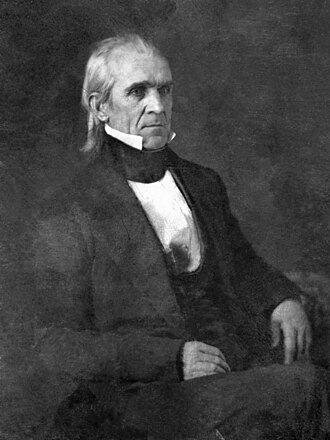 James K. Polk
Post-Graduate Legal • 23m
Order
Feb 24, 1848
⚖️✨ Zone 2 (Zone of Twilight) Constitutional Neutral
Executive Order—Death of John Quincy Adams
📜 Art. II §2: Commander-in-Chief Supervisory Authority
Washington, February 24, 1848. I. The following orders of the President of the United States and Secretary of War announce to the Army the death of the illustrious ex-President John Quincy Adams: BY THE PRESIDENT OF THE UNITED STATES. WASHINGTON, February 24, 1848 .
James K. Polk High School • 3m
Order
Dec 26, 1848
⚖️✨ Zone 2 (Zone of Twilight) Constitutional Neutral
Executive Order—Disposal of Flags Captured in the War With Mexico
📜 Art. II §2: Commander-in-Chief Supervisory Authority
The Secretary of War is directed to take measures to cause the flags, standards, and colors taken by the Army of the United States from their enemies in the recent war with Mexico to be deposited for the purpose specified in the act in the Military Academy at West Point.
James K. Polk Post-Graduate Legal • 1m
📜
Scholarly & Legal Citations
Exec. Order, [on the death of Andrew Jackson] (June 16, 1845), https://executiveordersarchive.org/orders/app-executive-order-the-death-andrew-jackson.
