By virtue of the authority vested in the President by section 5 (b) of the act of October 6, 1917, as amended (12 U.S.C. 95a), and in view of the continued existence of the national emergency declared by Proclamation No. 2914 of December 16, 1950, and the importance of strengthening the balance of payments position of the United States during this national emergency, it is hereby ordered: 1. (a) Any person subject to the jurisdiction of the United States who, alone or together with one or more affiliated persons, owns or acquires as much as a 10% interest in the voting securities, capital or earnings of a foreign business venture is prohibited on or after the effective date of this Order, except as expressly authorized by the Secretary of Commerce, from engaging in any transaction involving a direct or indirect transfer of capital to or within any foreign country or to any national thereof outside the United States. (b) The Secretary of Commerce is authorized to acquire, as he determines to be necessary or appropriate to strengthen the balance of payments position of the United States, that any person subject to the jurisdiction of the United States who, alone or together with one or more affiliated persons, owns or acquires as much as a 10% interest in the voting securities, capital or earnings of one or more foreign business ventures shall cause to he repatriated to the United States such part as the Secretary of Commerce may specify of (1) the earnings of such foreign business ventures which are attributable to such person's investments therein and (2) bank deposits and other short term financial assets which are held in foreign countries by or for the account of such person. Any person subject to the jurisdiction of the United States is required on or after the effective date of this Order to comply with any such requirement of the Secretary of Commerce. (c) The Secretary of Commerce shall exempt from the provisions of this section 1, to the extent delineated by the Board of Governors of the Federal Reserve System (hereinafter referred to as the Board), banks or financial institutions certified by the Board as being subject to the Federal Reserve Foreign Credit Restraint Programs, or to any program instituted by the Board under section 2 of this Order. 2. The Board is authorized in the event that it determines such action to be necessary or desirable to strengthen the balance of payments position of the United States: (a) to investigate, regulate or prohibit any transaction by any bank or other financial institution subject to the jurisdiction of the United States involving a direct or indirect transfer of capital to or within any foreign country or to any national thereof outside the United States; and (b) to require that any bank or financial institution subject to the jurisdiction of the United States shall cause to be repatriated to the, United States such part as the Board may specify of the bank deposits and other short term financial assets which are held in foreign countries by or for the account of such bank or financial institution. Any bank or financial institution subject to the jurisdiction of the United States shall comply with any such requirement of the Board on and after its effective date. 3. The Secretary of Commerce and the Board are respectively authorized, under authority delegated to each of them under this Order or otherwise available to them, to carry out the provisions of this Order, and to prescribe such definitions for any terms used herein, to issue such rules and regulations, orders, rulings, licenses and instructions, and to take such other actions, as each of them determines to be necessary or appropriate to carry out the purposes of this Order and their respective responsibilities hereunder. The Secretary of Commerce and the Board may each redelegate to any agency, instrumentality or official of the United States any authority under this Order, and may, in administering this Order, utilize the services of any other agencies, Federal or State, which are available and appropriate. 4. The Secretary of State shall advise the Secretary of Commerce and the Board with respect to matters under this Order involving foreign policy. The Secretary of Commerce and the Board shall consult as necessary and appropriate with each other and with the Secretary of the Treasury. 5. The delegations of authority in this Order shall not affect the authority of any agency or official pursuant to any other delegation of presidential authority, presently in effect or hereafter made, under section 5 (b) of the act of October 6, 1917, as amended (12 U.S.C. 95a). LYNDON B. JOHNSON The White House 10:45 a.m. Jan. 1, 1968 L.B.J. Ranch.
Executive Order 11387 ⚖️⚠️ Zone 3: Lowest Ebb Constitutional Friction / Overreach (-0.19)
📜 Art. I §8: Legislative Prerogative Tension (Purse & Commerce)
Executive Order 11387—Governing Certain Capital Transfers Abroad
Executive Brief • At a Glance
⏱️ 4 min read (790 words) •
● In Effect
🎯 Primary Mandate
Any person subject to the jurisdiction of the United States who, alone or together with one or more affiliated persons, owns or acquires as much as a 10% interest in the voting securities, capital or earnings of a foreign business venture is prohibited on or after the effective date of this Order, except as expressly authorized by the Secretary of Commerce, from engaging in any transaction involving a direct or indirect transfer of capital to or within any foreign country or to any national thereof outside the United States.
⚖️ Constitutional Footing
⚖️⚠️ Zone 3: Lowest Ebb
Incompatible with Expressed Will of Congress or High Friction
📜 Art. I §8: Legislative Prerogative Tension (Purse & Commerce)
🏛️ Scope & Affected Sectors
Sovereign State Governments & Localities Foreign Nations & International Entities Financial Institutions & Monetary Authorities
Plain-English Translation & Framers' Constitutional Analysis
Early Statesman synthesis distilling legal jargon into practical meaning, statutory anchors, and structural constitutional impacts.
Signed by President Lyndon B. Johnson on January 1, 1968, this order concerns Governing Certain Capital Transfers Abroad. 1. (a) Any person subject to the jurisdiction of the United States who, alone or together with one or more affiliated persons, owns or acquires as much as a 10% interest in the voting securities, capital or earnings of a foreign business venture is prohibited on or after the effective date of this Order, except as expressly authorized by the Secretary of Commerce, from engaging in any transaction involving a direct…
Constitutional Assessment: An early statesman would subject this decree to rigorous scrutiny under Article I, Section 8. The Framers deliberately committed commerce, taxation, tariffs, and revenue to Congress alone. To the extent this order imposes duties or financial burdens without explicit statutory pre-authorization, it creates friction with the separation of powers.
Key Directives & Operative Actions
▪
Any person subject to the jurisdiction of the United States who, alone or together with one or more affiliated persons, owns or acquires as much as a 10% interest in the voting securities, capital or earnings of a foreign business venture is prohibited on or after the effective date of this Order, except as expressly authorized by the Secretary of Commerce, from engaging in any transaction involving a direct or indirect transfer of capital to or within any foreign country or to any national thereof outside the United States.
▪
The Secretary of Commerce is authorized to acquire, as he determines to be necessary or appropriate to strengthen the balance of payments position of the United States, that any person subject to the jurisdiction of the United States who, alone or together with one or more affiliated persons, owns or acquires as much as a 10% interest in the voting securities, capital or earnings of one or more foreign business ventures shall cause to he repatriated to the United States such part as the Secretary of Commerce may specify of (1) the earnings of such foreign business ventures which are attributable to such person's investments therein and (2) bank deposits and other short term financial assets which are held in foreign countries by or for…
▪
The Secretary of Commerce shall exempt from the provisions of this section 1, to the extent delineated by the Board of Governors of the Federal Reserve System (hereinafter referred to as the Board), banks or financial institutions certified by the Board as being subject to the Federal Reserve Foreign Credit Restraint Programs, or to any program instituted by the Board under section 2 of this Order. 2.
▪
The Board is authorized in the event that it determines such action to be necessary or desirable to strengthen the balance of payments position of the United States: (a) to investigate, regulate or prohibit any transaction by any bank or other financial institution subject to the jurisdiction of the United States involving a direct or indirect transfer of capital to or within any foreign country or to any national thereof outside the United States; and (b) to require that any bank or financial institution subject to the jurisdiction of the United States shall cause to be repatriated to the, United States such part as the Board may specify of the bank deposits and other short term financial assets which are held in foreign countries by or…
Constitutional & Societal Entities Impacted
🏛️ Sovereign State Governments & Localities
🏛️ Foreign Nations & International Entities
🏛️ Financial Institutions & Monetary Authorities
Policy Areas & Topics
🏛️
The Framers' Constitutional Council
1787 PrismEvaluating this order against the constitutional debates of 1787 and the limits of Article II executive power.
⚖️⚠️ Zone 3 (Lowest Ebb)
§
"When the President takes measures incompatible with the expressed or implied will of Congress, his power is at its lowest ebb."
— Justice Robert H. Jackson, Youngstown Sheet & Tube Co. v. Sawyer (1952) Incompatible with Expressed Will of Congress or High Friction
JM
James Madison
Separation of Powers & Legislative Primacy
"The accumulation of all powers, legislative, executive, and judiciary, in the same hands... may justly be pronounced the very definition of tyranny." — Federalist No. 47 (1788)
Madison would express grave alarm over this order. By asserting independent authority in tension with legislative limits or the Bill of Rights, the Executive risks collapsing the separation of powers into unilateral rule. Under the Madisonian model, no emergency justifies the Executive substituting its decree for a deliberative Act of Congress.
Madisonian Stance: Strict Dissent (Overreach)
AH
Alexander Hamilton
The Energetic Executive & Unified Command
"The direction of war implies the direction of the common strength; and the power of directing and employing the common strength must be under the direction of the single hand of the Executive." — Federalist No. 74 (1788)
Hamilton would forcefully champion executive discretion here. For foreign entanglements, commerce defense, and national security, deliberative assemblies are too slow and faction-ridden. A unified, energetic Executive exercising swift command is precisely what the Philadelphia Convention intended for national preservation.
Hamiltonian Stance: Qualified Caution
GM
George Mason
Bill of Rights, Due Process & 10th Amendment
"The purse and the sword ought never to be in the same hands... nor the liberties of the citizen placed at the pleasure of a single magistrate." — Virginia Ratifying Convention (1788)
George Mason and the Anti-Federalists would sound a fierce warning. They feared that Article II would inevitably evolve into an elective monarchy. When an executive order impacts private rights, property, or civil liberties without individualized judicial process, Mason would see their darkest predictions verified.
Anti-Federalist Stance: Vehement Objection
📐
Five Measurable "Constitutional Friction" Dimensions
An objective audit measuring potential separation-of-powers tension against the United States Constitution and established Supreme Court doctrine.
⚠️ Elevated Constitutional Friction
79 / 100 friction index
Dimension 1 • Art. I, §1 & §8
High Friction
Legislative Encroachment & Purse
Touches upon core congressional prerogatives: raises appropriations reallocation, tariff imposition, or statutory preemption questions.
Benchmark: Power of the purse, taxes/tariffs, and rule of law reserved to Congress.
Dimension 2 • Art. II, §1 & §3
High Friction
Executive Scope & Faithfulness
Invokes broad unilateral or emergency executive authorities that test the constitutional boundary of the Take Care Clause.
Benchmark: Faithfully execute laws enacted by Congress vs. unilateral decree.
Dimension 3 • 10th Amendment
High Friction
Federalism & State Sovereignty
Creates friction with the Tenth Amendment by conditioning state grants, mandating local compliance, or preempting state police powers.
Benchmark: Police powers and un-delegated responsibilities reserved to the States.
Dimension 4 • 5th & 14th Amendments
Moderate Friction
Due Process & Individual Rights
Applies regulatory or compliance standards to private contractors or commercial entities.
Benchmark: Protection of private property, contracts, liberty, and procedural justice.
Dimension 5 • Separation of Powers
High Friction
Youngstown Jacksonian Tier
The order asserts independent Article II prerogative against statutory constraints, reallocates funds without explicit appropriation, or stretches executive power into realms constitutionally reserved to the legislature or judiciary.
Benchmark: Incompatible with Expressed Will of Congress or High Friction
⚖️
Audit Synthesis
This directive engages significant constitutional friction across statutory authorization, legislative prerogatives, or individual liberties.
Weighted composite: Art. I (25%), Art. II (25%), Federalism (15%), Due Process (15%), Youngstown (20%).
ℹ️
How to read these dimensions: Executive power expands whenever an administration acts without explicit statutory authorization from Congress (Article I), touches upon police powers historically reserved to the states (Tenth Amendment), or limits private rights and property without judicial process. A low friction score indicates strict concordance with enacted law; a high friction score highlights orders testing the limits of presidential discretion.
Total Words
790
4,728 characters
Estimated Read Time
4 min
@ 200 words / min
Flesch-Kincaid
24
Post-Graduate Legal
Text size:
🔗
Referenced By Later Executive Orders (1)
Subsequent presidents who cited, amended, continued, or revoked this directive in later orders.
References Executive Order 11490—Assigning Emergency Preparedness Functions to Federal Departments and Agencies
Richard Nixon • 1969-10-28
Related Executive Orders
Other executive actions signed by Lyndon B. Johnson around this period.
EO 11386 Dec 28, 1967
🏛️✅ Zone 1 (Maximum Authority) Fidelity (+0.33)
Executive Order 11386—Prescribing Arrangements for Coordination of the Activities of Regional Commissions and Activities of the Federal Government Relating to Regional Economic Development, and Establishing the Federal Advisory Council on Regional Economic Development
📜 Art. II §2: Commander-in-Chief Supervisory Authority
Functions of the Secretary of Commerce. The Secretary of Commerce shall (a) Provide the effective and continuing liaison required by section 104 of the Appalachian Regional Development Act of 1965 and by section 503 (c) of the Public Works and Economic Development Act of 1965…
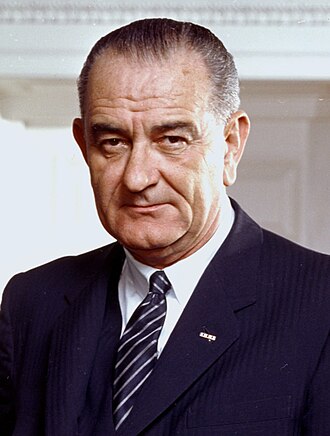 Lyndon B. Johnson
Post-Graduate Legal • 9m
EO 11388 Jan 15, 1968
⚖️✨ Zone 2 (Zone of Twilight) Constitutional Neutral
Executive Order 11388—Designation of Officers of the Department of Commerce to Act as Secretary of Commerce
📜 Art. II §1: Executive Discretion & Internal Operations
During any period when by reason of absence, disability, or vacancy in office, neither the Secretary of Commerce nor the Under Secretary of Commerce is available to exercise the powers or perform the duties of the office of Secretary, an Assistant Secretary of Commerce or the…
Lyndon B. Johnson College Level • 1m
EO 11385 Dec 16, 1967
⚖️✨ Zone 2 (Zone of Twilight) Constitutional Neutral
Executive Order 11385—Placing an Additional Position in Level IV of the Federal Executive Salary Schedule
📜 Art. II §1: Executive Discretion & Internal Operations
Of Executive Order No. 11248 of October 10, 1965, as amended, is further amended by adding thereto the following: (6) Deputy Administrator, Federal Highway Administration, Department of Transportation.
Lyndon B. Johnson College Level • 1m
EO 11390 Jan 22, 1968
⚖️⚠️ Zone 3 (Lowest Ebb) Friction (-0.19)
Executive Order 11390—Delegation of Certain Functions of the President to the Secretary of Defense
📜 Art. II §2: Commander-in-Chief / War Prerogative Tension
The Secretary of Defense, and, as designated by the said Secretary for this purpose, any of the Secretaries, Under Secretaries, and Assistant Secretaries of the military departments, are hereby designated and empowered to perform the following-described functions of the…
Lyndon B. Johnson Post-Graduate Legal • 3m
EO 11389 Jan 22, 1968
⚖️✨ Zone 2 (Zone of Twilight) Constitutional Neutral
Executive Order 11389—Placing an Additional Position in Level IV of the Federal Executive Salary Schedule
📜 Art. II §1: Executive Discretion & Internal Operations
Of Executive Order No. 11248 of October 10, 1965, as amended, is further amended by adding thereto the following: (7) Director, Office of Foreign Direct Investments, Department of Commerce.
Lyndon B. Johnson College Level • 1m
EO 11391 Jan 24, 1968
⚖️✨ Zone 2 (Zone of Twilight) Constitutional Neutral
Executive Order 11391—Amending the Selective Service Regulations
📜 Art. II §2: Commander-in-Chief Supervisory Authority
I hereby prescribe the following amendments of the Selective Service Regulations prescribed by Executive Orders No. 10344 of April 17, 1952, No. 10594 of January 31, 1955, and No. 10837 of September 14, 1959, and constituting portions of Part 1655—Registration of United States…
Lyndon B. Johnson Post-Graduate Legal • 2m
📜
Scholarly & Legal Citations
Exec. Order No. 11,387 (Jan. 1, 1968), https://executiveordersarchive.org/orders/app-executive-order-11387-governing-certain-capital-transfers-abroad.
