By virtue of the authority vested in me by Sections 3301 and 3302 of Title 5 of the United States Code, Section 301 of Title 3 of the United States Code, and as President of the United States of America, it is hereby ordered as follows: SECTION 1. There is hereby established the Presidential Management Intern Program, hereafter referred to as the Program, the purpose of which is to attract to Federal service men and women of exceptional management potential who have received special training in planning and managing public programs and policies. SEC. 2. Outstanding individuals who have pursued a course of study oriented toward public management at a graduate level educational institution and who, at the time of application, have recently received or will shortly receive an appropriate advanced degree, are eligible to apply for participation in the Program. SEC. 3. The United States Civil Service Commission, hereafter referred to as the Commission, shall develop appropriate procedures for the recruitment, screening, and selection of applicants possessing the qualifications described in Section 2 of this order. In developing these procedures, the Commission shall be guided by the following principles and policies: (a) The number of interns participating in the Program shall at no time exceed five hundred. (b) Final selection of interns shall be made by the head of the department, agency, or component within the Executive Office of the President in which the intern is to be employed, or by the designee thereof. (c) The procedures so developed shall provide for such affirmative action as the Commission deems appropriate to assure equal employment opportunity. (d) To the extent permitted by law, the Commission is authorized to enter into appropriate cooperative arrangements with State and local officials and appropriate private institutions for recruitment and screening of candidates for the Program. SEC. 4. Upon selection, candidates shall be appointed as interns to positions in Schedule A of the excepted service for a period not to exceed two years. Their tenure shall be governed by the following principles and policies: (a) Interns shall be assigned responsibilities consistent with their public management backgrounds and the purposes of this Program. (b) Continuation in the Program shall be contingent upon satisfactory performance by the interns throughout the internship period. (c) Except as provided in subsection (d) of this Section, service as interns shall confer no rights to further Federal employment in either the competitive or excepted service upon expiration of the two year internship period. (d) Interns may be granted competitive civil service status if they satisfactorily complete their two-year internships and meet all other requirements prescribed by the Commission. SEC. 5. The Commission shall prescribe such regulations as may be necessary to carry out the purposes of this order. JIMMY CARTER The White House, August 25, 1977. [Filed with the Office of the Federal Register, 3:27 p.m., August 25, 1977]
Executive Order 12008 🏛️✅ Zone 1: Maximum Authority Constitutional Fidelity (+0.29)
📜 10th Amend: Intergovernmental Federalism Cooperation
Executive Order 12008—Presidential Management Intern Program
Executive Brief • At a Glance
⏱️ 2 min read (477 words) •
● In Effect
🎯 Primary Mandate
There is hereby established the Presidential Management Intern Program, hereafter referred to as the Program, the purpose of which is to attract to Federal service men and women of exceptional management potential who have received special training in planning and managing public programs and policies.
⚖️ Constitutional Footing
🏛️✅ Zone 1: Maximum Authority
Express or Implied Congressional Authorization
📜 10th Amend: Intergovernmental Federalism Cooperation
🏛️ Scope & Affected Sectors
Sovereign State Governments & Localities Executive Departments & Federal Civil Servants Private Citizens & Property Owners
Plain-English Translation & Framers' Constitutional Analysis
Early Statesman synthesis distilling legal jargon into practical meaning, statutory anchors, and structural constitutional impacts.
Signed by President Jimmy Carter on August 25, 1977, this order concerns Presidential Management Intern Program. There is hereby established the Presidential Management Intern Program, hereafter referred to as the Program, the purpose of which is to attract to Federal service men and women of exceptional management potential who have received special training in planning and managing public programs and policies. SEC. 2.
Constitutional Assessment: Reviewed under the Tenth Amendment and the principle of dual federalism, this order touches upon domains traditionally reserved to the sovereign States. The Framers would caution against any attempt to commandeer state officers or displace local police powers through federal executive fiat.
Key Directives & Operative Actions
▪
There is hereby established the Presidential Management Intern Program, hereafter referred to as the Program, the purpose of which is to attract to Federal service men and women of exceptional management potential who have received special training in planning and managing public programs and policies.
▪
The United States Civil Service Commission, hereafter referred to as the Commission, shall develop appropriate procedures for the recruitment, screening, and selection of applicants possessing the qualifications described in Section 2 of this order.
▪
In developing these procedures, the Commission shall be guided by the following principles and policies: (a) The number of interns participating in the Program shall at no time exceed five hundred.
▪
Final selection of interns shall be made by the head of the department, agency, or component within the Executive Office of the President in which the intern is to be employed, or by the designee thereof.
Constitutional & Societal Entities Impacted
🏛️ Sovereign State Governments & Localities
🏛️ Executive Departments & Federal Civil Servants
🏛️ Private Citizens & Property Owners
Policy Areas & Topics
🏛️
The Framers' Constitutional Council
1787 PrismEvaluating this order against the constitutional debates of 1787 and the limits of Article II executive power.
🏛️✅ Zone 1 (Maximum Authority)
§
"When the President acts pursuant to an express or implied authorization of Congress, his authority is at its maximum, for it includes all that he possesses in his own right plus all that Congress can delegate."
— Justice Robert H. Jackson, Youngstown Sheet & Tube Co. v. Sawyer (1952) Express or Implied Congressional Authorization
JM
James Madison
Separation of Powers & Legislative Primacy
"The constitutional magistracy was designed not to invent policy, but to be the faithful instrument of the laws passed by the people's representatives." — Speech in the First Congress (1789)
Madison would approve the structural posture of this order. The President acts strictly in subordination to statutory authority granted under Article II, Section 3 ("take Care that the Laws be faithfully executed"). The checks and balances hold firm because the policy origin remains with the legislature.
Madisonian Stance: Concurring (Statutory)
AH
Alexander Hamilton
The Energetic Executive & Unified Command
"A feeble Executive implies a feeble execution of the government; and a government ill executed, whatever it may be in theory, must be, in practice, a bad government." — Federalist No. 70 (1788)
Hamilton would view this directive as the natural and indispensable functioning of administrative leadership. Without the power to coordinate agencies, manage personnel, and resolve operational ambiguities, the modern presidency would be reduced to an impotent figurehead.
Hamiltonian Stance: Supportive of Execution
GM
George Mason
Bill of Rights, Due Process & 10th Amendment
"The powers not delegated to the United States by the Constitution, nor prohibited by it to the States, are reserved to the States respectively, or to the people." — 10th Amendment to the US Constitution (1791)
Mason would scrutinize whether this federal directive intrudes into police powers, land stewardship, or municipal domains historically reserved to local citizens. The Anti-Federalist demand is that federal administration must never supplant state self-governance.
Anti-Federalist Stance: Eternal Vigilance Required
📐
Five Measurable "Constitutional Friction" Dimensions
An objective audit measuring potential separation-of-powers tension against the United States Constitution and established Supreme Court doctrine.
⚖️ Discretionary Twilight Zone
46 / 100 friction index
Dimension 1 • Art. I, §1 & §8
Moderate Friction
Legislative Encroachment & Purse
Administers commerce or fiscal programs requiring ongoing statutory delegation and legislative oversight.
Benchmark: Power of the purse, taxes/tariffs, and rule of law reserved to Congress.
Dimension 2 • Art. II, §1 & §3
Moderate Friction
Executive Scope & Faithfulness
Directs internal executive branch machinery, agency workflows, and federal personnel.
Benchmark: Faithfully execute laws enacted by Congress vs. unilateral decree.
Dimension 3 • 10th Amendment
High Friction
Federalism & State Sovereignty
Creates friction with the Tenth Amendment by conditioning state grants, mandating local compliance, or preempting state police powers.
Benchmark: Police powers and un-delegated responsibilities reserved to the States.
Dimension 4 • 5th & 14th Amendments
Moderate Friction
Due Process & Individual Rights
Applies regulatory or compliance standards to private contractors or commercial entities.
Benchmark: Protection of private property, contracts, liberty, and procedural justice.
Dimension 5 • Separation of Powers
Low Friction
Youngstown Jacksonian Tier
The President operates strictly as the constitutional Chief Executive, carrying out policy established by Congress with strong statutory backing.
Benchmark: Express or Implied Congressional Authorization
⚖️
Audit Synthesis
This order operates within Justice Jackson’s Zone of Twilight, resting upon concurrent presidential authority or congressional silence.
Weighted composite: Art. I (25%), Art. II (25%), Federalism (15%), Due Process (15%), Youngstown (20%).
ℹ️
How to read these dimensions: Executive power expands whenever an administration acts without explicit statutory authorization from Congress (Article I), touches upon police powers historically reserved to the states (Tenth Amendment), or limits private rights and property without judicial process. A low friction score indicates strict concordance with enacted law; a high friction score highlights orders testing the limits of presidential discretion.
Total Words
477
3,067 characters
Estimated Read Time
2 min
@ 200 words / min
Flesch-Kincaid
16.5
Post-Graduate Legal
Text size:
🔗
Referenced By Later Executive Orders (1)
Subsequent presidents who cited, amended, continued, or revoked this directive in later orders.
Ronald Reagan • 1982-05-24
Related Executive Orders
Other executive actions signed by Jimmy Carter around this period.
EO 12007 Aug 22, 1977
🏛️✅ Zone 1 (Maximum Authority) Fidelity (+0.29)
Executive Order 12007—Presidential Advisory Committees
📜 Art. II §3: Faithful Execution of Statutory Law
The Citizens' Advisory Council on the Status of Women is terminated. (b) Executive Order No. 11126 of November 1, 1963, as amended by Executive Order No. 11221 of May 6, 1965, is further amended as follows: (1) Subsection (5) of Section 102 is revoked.
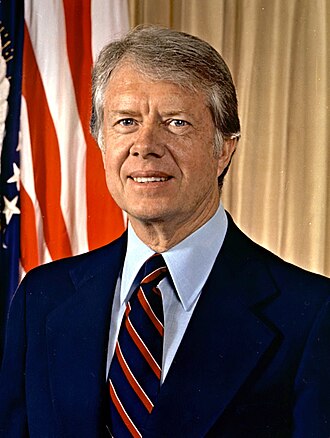 Jimmy Carter
High School • 2m
EO 12009 Sep 13, 1977
⚖️✨ Zone 2 (Zone of Twilight) Constitutional Neutral
Executive Order 12009—Department of Energy
📜 5th Amend: Regulatory Execution with Due Process
Pursuant to Section 901 of the Department of Energy Organization Act, I hereby prescribe October 1, 1977, as the effective date of that Act. SEC. 2.
Jimmy Carter Post-Graduate Legal • 1m
EO 12006 Jul 29, 1977
⚖️✨ Zone 2 (Zone of Twilight) Constitutional Neutral
Executive Order 12006—Exemption From Mandatory Retirement
📜 Art. II §1: Executive Discretion & Internal Operations
Joseph Minetti, Member, Civil Aeronautics Board, will become subject to mandatory retirement for age on July 31, 1977, under the provisions of Section 8335 of Title 5 of the United States Code unless exempted by Executive order.
Jimmy Carter High School • 1m
EO 12005 Jul 23, 1977
🏛️✅ Zone 1 (Maximum Authority) Constitutional Neutral
Executive Order 12005—Generalized System of Preferences for Developing Countries
📜 Art. I §8: Delegated Tariff & Commerce Execution
In order to redefine an existing item for purposes of the Generalized System of Preferences (GSP), the Tariff Schedules of the United States (TSUS) are modified by deleting from item 791.74, TSUS, the description: "In part of textile materials the aggregate weight of which…
Jimmy Carter High School • 1m
EO 12010 Sep 28, 1977
⚖️✨ Zone 2 (Zone of Twilight) Constitutional Neutral
Executive Order 12010—Federal Civilian and Military Pay Increases
📜 Art. II §2: Commander-in-Chief Supervisory Authority
Statutory Pay Systems. Pursuant to the provisions of subchapter I of Chapter 53 of Title 5 of the United States Code, the rates of basic pay and salaries are adjusted, as set forth at the schedules attached hereto and made a part hereof, for the following statutory pay systems…
Jimmy Carter High School • 2m
EO 12011 Sep 30, 1977
⚖️✨ Zone 2 (Zone of Twilight) Constitutional Neutral
Executive Order 12011—Exemption From Mandatory Retirement
📜 Art. II §1: Executive Discretion & Internal Operations
Joseph Minetti, Member, Civil Aeronautics Board, became subject to mandatory retirement for age on July 31, 1977, under the provisions of Section 8335 of Title 5 of the United States Code unless exempted by Executive Order.
Jimmy Carter High School • 1m
📜
Scholarly & Legal Citations
Exec. Order No. 12,008 (Aug. 25, 1977), https://executiveordersarchive.org/orders/app-executive-order-12008-presidential-management-intern-program.
