By virtue of the authority vested in me as President by the Constitution of the United States of America, in order to provide coordinated Federal economic adjustment assistance necessitated by changes in Department of Defense activities, it is hereby ordered as follows: SECTION 1. Functions of the Secretary of Defense. (a) The Secretary shall, through the Economic Adjustment Committee, design and establish an Economic Adjustment Program to assist in the alleviation of serious economic and social impacts that result from major Defense realignments. The program shall provide for: 1. Identification of Defense-related impact problems of States, metropolitan areas, or communities that require assistance. 2. Preparation of development strategies and action plans to coordinate Federal, State and local economic adjustment efforts. 3. Strengthened and uniform economic impact analysis and analysis of community requirements for Federal economic adjustment resources, prior to base realignment action. 4. Timely and earliest possible consultation and cooperation with local, State and Federal officials concerning impact problems and coordinated interagency and intergovernmental adjustment assistance. 5. A clearinghouse service to exchange information among Federal, State and local officials involved in the resolution of community adjustment problems; e.g., previous studies, technical information, and sources of public and private financing. 6. Application of consistent policies, practices, and procedures in the administration of Federal programs that are utilized to assist Defense impact communities. 7. Encouragement of effective State and regional cooperation and concerted involvement of public interest groups and private sector organizations in Defense adjustment activities. 8. Development, with representatives of appropriate agencies, of uniform criteria for the determination .of social economic impact of a particular realignment. 9. Identification and strengthening of existing agency mechanisms to better coordinate employment opportunities for displaced agency personnel. 10. Increased attractiveness to the private sector of interim usage of lands and buildings and ways of streamlining property disposal procedures to enable impacted communities to acquire base property for job-generation purposes as military activities phase down. (b) The Secretary of Defense shall ensure that sufficient resources and personnel are allocated to carry out these functions. SEC. 2. Economic Adjustment Committee. (a) The Economic Adjustment Committee is hereby continued. (b) The Committee shall be composed of the following, or a principal deputy, and such others as the President may designate: (1) The Secretary of Defense, who shall be the Chairman of the Committee. (2) The Secretary of Agriculture. (3) The Secretary of Commerce. (4) The Secretary of Energy. (5) The Secretary of Health, Education, and Welfare. (6) The Secretary of Housing and Urban Development. (7) The Secretary of the Interior. (8) The Secretary of Labor. (9) The Secretary of Transportation. (10) The Attorney General. (11) The Chairman, Council of Economic Advisers. (12) The Director of the Office of Management and Budget. (13) The Director of the United States Arms Control and Disarmament Agency. (14) The Administrator of the Environmental Protection Agency. (15) The Director of the Community Services Administration. (16) The Administrator of General Services. (17) The Administrator of the Small Business Administration. (18) The Chairman of the United States Civil Service Commission. (c) The Committee shall advise, assist, and support the Secretary of Defense's Economic Adjustment activities. (d) The Secretary of Defense shall provide all necessary administrative support for the Committee. SEC. 3. Responsibility of Executive Agencies. (a) The head of each agency represented on the Economic Adjustment Committee shall designate a permanent representative to: (1) serve as liaison with the Secretary of Defense's economic adjustment staff, (2) coordinate agency support and participation in assistance projects, and (3) assist in resolving community impact problems. (b) All Executive agencies shall: (1) Support, to the extent permitted by law, the economic adjustment assistance activities of the Secretary of Defense. Such support shall include the use and application of personnel, technical expertise, legal authorities, and available financial resources to the extent required to provide a coordinated Federal response to the needs of individual communities, States, and regions adversely affected by necessary Defense changes. (2) Afford priority consideration to community requests for Federal technical assistance, financial resources, excess or surplus property, or other requirements that are part of a comprehensive plan issued by the Economic Adjustment Committee. SEC. 4. Construction. Nothing in this Order shall be construed as subjecting any function vested by law in, or assigned pursuant to law to, any agency or head thereof to the authority of any other agency or officer or as abrogating or restricting any such function in any manner. JIMMY CARTER The White House, March 27, 1978. [Filed with the Office of the Federal Register, 1:15 p.m., March 28, 1978]
Executive Order 12049 🏛️✅ Zone 1: Maximum Authority Constitutional Fidelity (+0.47)
📜 Art. II §2: Commander-in-Chief Supervisory Authority
Executive Order 12049—Defense Economic Adjustment Programs
Executive Brief • At a Glance
⏱️ 4 min read (756 words) •
● In Effect
🎯 Primary Mandate
The Secretary shall, through the Economic Adjustment Committee, design and establish an Economic Adjustment Program to assist in the alleviation of serious economic and social impacts that result from major Defense realignments.
⚖️ Constitutional Footing
🏛️✅ Zone 1: Maximum Authority
Express or Implied Congressional Authorization
📜 Art. II §2: Commander-in-Chief Supervisory Authority
🏛️ Scope & Affected Sectors
Armed Forces & Military Establishments Sovereign State Governments & Localities Executive Departments & Federal Civil Servants Private Citizens & Property Owners
Plain-English Translation & Framers' Constitutional Analysis
Early Statesman synthesis distilling legal jargon into practical meaning, statutory anchors, and structural constitutional impacts.
Signed by President Jimmy Carter on March 27, 1978, this order concerns Defense Economic Adjustment Programs. Functions of the Secretary of Defense. (a) The Secretary shall, through the Economic Adjustment Committee, design and establish an Economic Adjustment Program to assist in the alleviation of serious economic and social impacts that result from major Defense realignments. The program shall provide for: 1.
Constitutional Assessment: Scrutinized through Article II, Section 2, this action exercises the President's constitutional role as Commander in Chief. Early Framers recognized broad executive discretion in commanding military forces during conflict, provided it remains bounded by congressional declarations and respects civilian domestic courts.
Key Directives & Operative Actions
▪
The Secretary shall, through the Economic Adjustment Committee, design and establish an Economic Adjustment Program to assist in the alleviation of serious economic and social impacts that result from major Defense realignments.
▪
Identification of Defense-related impact problems of States, metropolitan areas, or communities that require assistance. 2.
▪
The Secretary of Defense shall ensure that sufficient resources and personnel are allocated to carry out these functions.
▪
The Economic Adjustment Committee is hereby continued.
Constitutional & Societal Entities Impacted
🏛️ Armed Forces & Military Establishments
🏛️ Sovereign State Governments & Localities
🏛️ Executive Departments & Federal Civil Servants
🏛️ Private Citizens & Property Owners
🏛️ Public Health & Medical Institutions
Policy Areas & Topics
🏛️
The Framers' Constitutional Council
1787 PrismEvaluating this order against the constitutional debates of 1787 and the limits of Article II executive power.
🏛️✅ Zone 1 (Maximum Authority)
§
"When the President acts pursuant to an express or implied authorization of Congress, his authority is at its maximum, for it includes all that he possesses in his own right plus all that Congress can delegate."
— Justice Robert H. Jackson, Youngstown Sheet & Tube Co. v. Sawyer (1952) Express or Implied Congressional Authorization
JM
James Madison
Separation of Powers & Legislative Primacy
"The constitutional magistracy was designed not to invent policy, but to be the faithful instrument of the laws passed by the people's representatives." — Speech in the First Congress (1789)
Madison would approve the structural posture of this order. The President acts strictly in subordination to statutory authority granted under Article II, Section 3 ("take Care that the Laws be faithfully executed"). The checks and balances hold firm because the policy origin remains with the legislature.
Madisonian Stance: Concurring (Statutory)
AH
Alexander Hamilton
The Energetic Executive & Unified Command
"The direction of war implies the direction of the common strength; and the power of directing and employing the common strength must be under the direction of the single hand of the Executive." — Federalist No. 74 (1788)
Hamilton would forcefully champion executive discretion here. For foreign entanglements, commerce defense, and national security, deliberative assemblies are too slow and faction-ridden. A unified, energetic Executive exercising swift command is precisely what the Philadelphia Convention intended for national preservation.
Hamiltonian Stance: Strong Prerogative Support
GM
George Mason
Bill of Rights, Due Process & 10th Amendment
"The president will be surrounded by flatterers and sycophants... and the great powers of the executive will gradually absorb the liberties of the people." — Cato IV (Anti-Federalist, 1787)
The Anti-Federalist prism advises continuous democratic vigilance. Even routine administrative directives aggregate centralized federal power away from town halls and state assemblies toward a distant executive apparatus.
Anti-Federalist Stance: Eternal Vigilance Required
📐
Five Measurable "Constitutional Friction" Dimensions
An objective audit measuring potential separation-of-powers tension against the United States Constitution and established Supreme Court doctrine.
⚖️ Discretionary Twilight Zone
39 / 100 friction index
Dimension 1 • Art. I, §1 & §8
Low Friction
Legislative Encroachment & Purse
Operates within delegated statutory execution without modifying legislative appropriations or taxing powers.
Benchmark: Power of the purse, taxes/tariffs, and rule of law reserved to Congress.
Dimension 2 • Art. II, §1 & §3
Moderate Friction
Executive Scope & Faithfulness
Directs internal executive branch machinery, agency workflows, and federal personnel.
Benchmark: Faithfully execute laws enacted by Congress vs. unilateral decree.
Dimension 3 • 10th Amendment
High Friction
Federalism & State Sovereignty
Creates friction with the Tenth Amendment by conditioning state grants, mandating local compliance, or preempting state police powers.
Benchmark: Police powers and un-delegated responsibilities reserved to the States.
Dimension 4 • 5th & 14th Amendments
Moderate Friction
Due Process & Individual Rights
Applies regulatory or compliance standards to private contractors or commercial entities.
Benchmark: Protection of private property, contracts, liberty, and procedural justice.
Dimension 5 • Separation of Powers
Low Friction
Youngstown Jacksonian Tier
The President operates strictly as the constitutional Chief Executive, carrying out policy established by Congress with strong statutory backing.
Benchmark: Express or Implied Congressional Authorization
⚖️
Audit Synthesis
This order operates within Justice Jackson’s Zone of Twilight, resting upon concurrent presidential authority or congressional silence.
Weighted composite: Art. I (25%), Art. II (25%), Federalism (15%), Due Process (15%), Youngstown (20%).
ℹ️
How to read these dimensions: Executive power expands whenever an administration acts without explicit statutory authorization from Congress (Article I), touches upon police powers historically reserved to the states (Tenth Amendment), or limits private rights and property without judicial process. A low friction score indicates strict concordance with enacted law; a high friction score highlights orders testing the limits of presidential discretion.
Total Words
756
5,284 characters
Estimated Read Time
4 min
@ 200 words / min
Flesch-Kincaid
15.2
College Level
Text size:
🔗
Referenced By Later Executive Orders (1)
Subsequent presidents who cited, amended, continued, or revoked this directive in later orders.
George Bush • 1992-01-15
Related Executive Orders
Other executive actions signed by Jimmy Carter around this period.
EO 12048 Mar 27, 1978
🏛️✅ Zone 1 (Maximum Authority) Fidelity (+0.23)
Executive Order 12048—International Communication Agency
📜 5th Amend: Regulatory Execution with Due Process
Reorganization Plan No. 2 of 1977 (42 FR 62461), which establishes the International Communication Agency, except for Section 7(a) (14) thereof, is hereby effective.
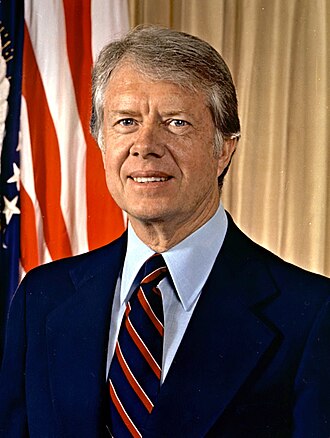 Jimmy Carter
Post-Graduate Legal • 3m
EO 12047 Mar 27, 1978
⚖️✨ Zone 2 (Zone of Twilight) Constitutional Neutral
Executive Order 12047—Imported Objects of Cultural Significance
📜 5th Amend: Regulatory Execution with Due Process
The Director of the International Communication Agency is designated and empowered to perform the functions conferred upon the President by the above-mentioned Act and shall be deemed to be authorized, without the approval, ratification, or other action of the President, (1) to…
Jimmy Carter College Level • 2m
EO 12046 Mar 27, 1978
⚖️⚠️ Zone 3 (Lowest Ebb) Friction (-0.19)
Executive Order 12046—Telecommunications Functions
📜 Art. II §2: Commander-in-Chief / War Prerogative Tension
Implementation of Reorganization Plan. 1-101. The transfer of all the functions of the Office of Telecommunications Policy and of its Director, as provided by Section 5B of Reorganization Plan No. 1 of 1977 (42 FR 56101), is hereby effective. 1-102.
Jimmy Carter College Level • 18m
EO 12045 Mar 27, 1978
⚖️✨ Zone 2 (Zone of Twilight) Constitutional Neutral
Executive Order 12045—Domestic Council, Office of Drug Abuse Policy, and Economic Opportunity Council
📜 5th Amend: Regulatory Execution with Due Process
The transfer of all functions of the Domestic Council, as provided by Section 5D of Reorganization Plan No. 1 of 1977 (42 FR 56101), is hereby effective.
Jimmy Carter High School • 3m
EO 12044 Mar 23, 1978
⚖️✨ Zone 2 (Zone of Twilight) Constitutional Neutral
Executive Order 12044—Improving Government Regulations
📜 Art. II §2: Commander-in-Chief Supervisory Authority
As President of the United States of America, I direct each Executive Agency to adopt procedures to improve existing and future regulations. SECTION 1. Policy. Regulations shall be as simple and clear as possible. They shall achieve legislative goals effectively and efficiently.
Jimmy Carter Post-Graduate Legal • 9m
EO 12050 Apr 4, 1978
🏛️✅ Zone 1 (Maximum Authority) Fidelity (+0.29)
Executive Order 12050—National Advisory Committee for Women
📜 Art. II §3: Faithful Execution of Statutory Law
Establishment of a National Advisory Committee for Women. There is established a National Advisory Committee for Women (hereafter the Committee). SEC. 2. Membership.
Jimmy Carter College Level • 3m
📜
Scholarly & Legal Citations
Exec. Order No. 12,049 (Mar. 27, 1978), https://executiveordersarchive.org/orders/app-executive-order-12049-defense-economic-adjustment-programs.
