By the authority vested in me as President by the Constitution of the United States of America, and in order to ensure that Federal agency actions protect the extraordinary natural, scenic, recreational and ecological resources in the Lake Tahoe Region (as defined by Public Law 91-148), an area of national concern, it is hereby ordered as follows: 1-1. Tahoe Federal Coordinating Council. 1-101. There is established an interagency committee to be known as the Tahoe Federal Coordinating Council. 1-102. The Council shall be composed of representatives from the following Executive agencies (those of the Western Federal Regional Council, Region Ix): (a) Department of Defense. (b) Department of the Interior. (c) Department of Agriculture. (d) Department of Commerce. (e) Department of Health and Human Services. (f) Department of Housing and Urban Development. (g) Department of Transportation. (h) Environmental Protection Agency. 1-103. The Council shall be chaired by the representative from the Department of Agriculture, which shall be responsible for providing administrative support. 1-104. Other agencies may be invited to designate representatives to participate in the activities of the Council from time to time. 1-2. Environmental Thresholds. 1-201. (a) The Council shall develop and issue environmental quality thresholds and carrying capacities for the air, water, and terrestrial components of the area known as the Lake Tahoe Region (Public Law 91-148), which lies within the States of California and Nevada. (b) These thresholds and carrying capacities shall be developed in consultation with the States of California and Nevada, the local governments in and around the area, and the public. (c) These thresholds and carrying capacities shall be based on a refinement and a periodic updating of the Western Federal Regional Council's "Lake Tahoe Environment Assessment" issued during February, 1980, and on other appropriate information. 1-202. The Council shall assist the State and local governments of California and Nevada in adopting and utilizing these thresholds and carrying capacities. 1-203. These thresholds and carrying capacities shall, to the extent permitted by law, be utilized by Executive agencies and the Council in determining the impact of Federal actions on the environment of the Region. 1-3. Environmental Actions. 1-301. An Executive agency shall, prior to authorizing any undertaking within the Region, whether by taking direct action or approving a license, permit, or financial assistance, determine if that undertaking will have a significant or potentially significant adverse effect on the environment of the Region. This determination shall be made in writing. It shall take into account the thresholds and carrying capacities developed by the Council. 1-302. The Executive agency shall transmit to the Council a copy of its determination as to the environmental impact on the Region. 1-303. (a) The Council will promptly review the agency determinations as to the environmental effect on the Region. The Council shall ensure that there is adequate opportunity for public comment on the agency determination. (b) If the Council concludes that the action to be taken would be compatible with the environment of the Region, the Chairman of the Council shall promptly so notify the agency. (c) If the Council concludes that the action to be taken would have a significant adverse impact on the resources and ecological values of the Region, the Chairman of the Council shall recommend to the responsible Executive agency that the action not be undertaken or that it be modified to eliminate the adverse impact. 1-304. If the agency disagrees with the recommendations of the Council, the Chairman of the Council shall promptly refer the matter to the Council on Environmental Quality for its recommendation as to the prompt resolution of any disagreement. 1-305. Until the thresholds and carrying capacities are issued, Executive agencies shall, to the extent permitted by law, not take any direct action nor approve any license, permit, or financial assistance in the Region which would significantly (a) stimulate additional development in environmentally sensitive areas as defined by land use plans or zoning ordinances of the Region, or (b) promote automobile traffic into the Region. 1-306. Until the thresholds and carrying capacities are issued, Executive agencies shall review agency actions in the Region which may have an effect on the Region's overall waste treatment planning. This review shall determine if such actions should be deferred until waste water treatment plans, as provided by Section 208 of the Federal Water Pollution Control Act (33 U.S.C. 1288), are adopted by the States of California and Nevada and approved by the Environmental Protection Agency. 1-4. General Provisions. 1-401. The Chairman of the Council on Environmental Quality and the Secretary of Agriculture shall advise the President from time to time on the effectiveness of this Order. They shall recommend other administrative action which may be taken to improve the coordination of agency actions and decisions whenever such coordination would protect and enhance the Region's natural and ecological values. 1-402. Nothing in this Order shall be construed to limit, delay, or prohibit any agency action which is essential for the protection of public health or safety, for national security, or for the maintenance or rehabilitation of environmental quality within the Region. JIMMY CARTER The White House, October 15, 1980. [Filed with the Office of the Federal Register, 10:43 a.m., October 15, 1980]
Executive Order 12247 🏛️✅ Zone 1: Maximum Authority Constitutional Fidelity (+0.44)
📜 Art. II §2: Commander-in-Chief Supervisory Authority
Executive Order 12247—Federal Actions in the Lake Tahoe Region
Executive Brief • At a Glance
⏱️ 4 min read (863 words) •
● In Effect
🎯 Primary Mandate
There is established an interagency committee to be known as the Tahoe Federal Coordinating Council. 1-102.
⚖️ Constitutional Footing
🏛️✅ Zone 1: Maximum Authority
Express or Implied Congressional Authorization
📜 Art. II §2: Commander-in-Chief Supervisory Authority
🏛️ Scope & Affected Sectors
Armed Forces & Military Establishments Sovereign State Governments & Localities Executive Departments & Federal Civil Servants Private Citizens & Property Owners
Plain-English Translation & Framers' Constitutional Analysis
Early Statesman synthesis distilling legal jargon into practical meaning, statutory anchors, and structural constitutional impacts.
Signed by President Jimmy Carter on October 15, 1980, this order concerns Federal Actions in the Lake Tahoe Region. 1-1. Tahoe Federal Coordinating Council. 1-101. There is established an interagency committee to be known as the Tahoe Federal Coordinating Council. 1-102. The Council shall be composed of representatives from the following Executive agencies (those of the Western Federal Regional Council, Region Ix): (a) Department of Defense. (b) Department of the Interior. (c) Department of Agriculture. (d) Department of Commerce.
Constitutional Assessment: Scrutinized through Article II, Section 2, this action exercises the President's constitutional role as Commander in Chief. Early Framers recognized broad executive discretion in commanding military forces during conflict, provided it remains bounded by congressional declarations and respects civilian domestic courts.
Key Directives & Operative Actions
▪
There is established an interagency committee to be known as the Tahoe Federal Coordinating Council. 1-102.
▪
The Council shall be composed of representatives from the following Executive agencies (those of the Western Federal Regional Council, Region Ix): (a) Department of Defense.
▪
The Council shall be chaired by the representative from the Department of Agriculture, which shall be responsible for providing administrative support. 1-104.
▪
Other agencies may be invited to designate representatives to participate in the activities of the Council from time to time. 1-2.
Constitutional & Societal Entities Impacted
🏛️ Armed Forces & Military Establishments
🏛️ Sovereign State Governments & Localities
🏛️ Executive Departments & Federal Civil Servants
🏛️ Private Citizens & Property Owners
🏛️ Public Health & Medical Institutions
Policy Areas & Topics
🏛️
The Framers' Constitutional Council
1787 PrismEvaluating this order against the constitutional debates of 1787 and the limits of Article II executive power.
🏛️✅ Zone 1 (Maximum Authority)
§
"When the President acts pursuant to an express or implied authorization of Congress, his authority is at its maximum, for it includes all that he possesses in his own right plus all that Congress can delegate."
— Justice Robert H. Jackson, Youngstown Sheet & Tube Co. v. Sawyer (1952) Express or Implied Congressional Authorization
JM
James Madison
Separation of Powers & Legislative Primacy
"The constitutional magistracy was designed not to invent policy, but to be the faithful instrument of the laws passed by the people's representatives." — Speech in the First Congress (1789)
Madison would approve the structural posture of this order. The President acts strictly in subordination to statutory authority granted under Article II, Section 3 ("take Care that the Laws be faithfully executed"). The checks and balances hold firm because the policy origin remains with the legislature.
Madisonian Stance: Concurring (Statutory)
AH
Alexander Hamilton
The Energetic Executive & Unified Command
"The direction of war implies the direction of the common strength; and the power of directing and employing the common strength must be under the direction of the single hand of the Executive." — Federalist No. 74 (1788)
Hamilton would forcefully champion executive discretion here. For foreign entanglements, commerce defense, and national security, deliberative assemblies are too slow and faction-ridden. A unified, energetic Executive exercising swift command is precisely what the Philadelphia Convention intended for national preservation.
Hamiltonian Stance: Strong Prerogative Support
GM
George Mason
Bill of Rights, Due Process & 10th Amendment
"The president will be surrounded by flatterers and sycophants... and the great powers of the executive will gradually absorb the liberties of the people." — Cato IV (Anti-Federalist, 1787)
The Anti-Federalist prism advises continuous democratic vigilance. Even routine administrative directives aggregate centralized federal power away from town halls and state assemblies toward a distant executive apparatus.
Anti-Federalist Stance: Eternal Vigilance Required
📐
Five Measurable "Constitutional Friction" Dimensions
An objective audit measuring potential separation-of-powers tension against the United States Constitution and established Supreme Court doctrine.
⚖️ Discretionary Twilight Zone
32 / 100 friction index
Dimension 1 • Art. I, §1 & §8
Low Friction
Legislative Encroachment & Purse
Operates within delegated statutory execution without modifying legislative appropriations or taxing powers.
Benchmark: Power of the purse, taxes/tariffs, and rule of law reserved to Congress.
Dimension 2 • Art. II, §1 & §3
Moderate Friction
Executive Scope & Faithfulness
Directs internal executive branch machinery, agency workflows, and federal personnel.
Benchmark: Faithfully execute laws enacted by Congress vs. unilateral decree.
Dimension 3 • 10th Amendment
Moderate Friction
Federalism & State Sovereignty
Engages state and local partners in cooperative federalism programs.
Benchmark: Police powers and un-delegated responsibilities reserved to the States.
Dimension 4 • 5th & 14th Amendments
Moderate Friction
Due Process & Individual Rights
Applies regulatory or compliance standards to private contractors or commercial entities.
Benchmark: Protection of private property, contracts, liberty, and procedural justice.
Dimension 5 • Separation of Powers
Low Friction
Youngstown Jacksonian Tier
The President operates strictly as the constitutional Chief Executive, carrying out policy established by Congress with strong statutory backing.
Benchmark: Express or Implied Congressional Authorization
⚖️
Audit Synthesis
This order operates within Justice Jackson’s Zone of Twilight, resting upon concurrent presidential authority or congressional silence.
Weighted composite: Art. I (25%), Art. II (25%), Federalism (15%), Due Process (15%), Youngstown (20%).
ℹ️
How to read these dimensions: Executive power expands whenever an administration acts without explicit statutory authorization from Congress (Article I), touches upon police powers historically reserved to the states (Tenth Amendment), or limits private rights and property without judicial process. A low friction score indicates strict concordance with enacted law; a high friction score highlights orders testing the limits of presidential discretion.
Total Words
863
5,647 characters
Estimated Read Time
4 min
@ 200 words / min
Flesch-Kincaid
15.6
College Level
Text size:
🔗
Referenced By Later Executive Orders (1)
Subsequent presidents who cited, amended, continued, or revoked this directive in later orders.
Ronald Reagan • 1981-03-12
Related Executive Orders
Other executive actions signed by Jimmy Carter around this period.
EO 12248 Oct 16, 1980
🏛️✅ Zone 1 (Maximum Authority) Fidelity (+0.23)
Executive Order 12248—Federal Civilian and Military Pay Increases
📜 Art. II §2: Commander-in-Chief Supervisory Authority
1-1. Adjusted Rates of Pay and Allowances. 1-101. Statutory Pay Systems. Pursuant to the provisions of subchapter 1 of Chapter 53 of Title 5 of the United States Code, the rates of basic pay and salaries are adjusted, as set forth at the schedules attached hereto and made a…
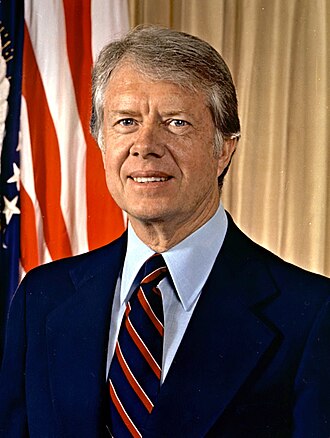 Jimmy Carter
Grade 9 • 2m
EO 12246 Oct 10, 1980
🏛️✅ Zone 1 (Maximum Authority) Constitutional Neutral
Executive Order 12246—Cuban and Haitian Entrants
📜 10th Amend: Intergovernmental Federalism Cooperation
1-101. All the functions vested in the President by Section 501(c) of the Refugee Education Assistance Act of 1980, are hereby delegated to the Secretary of State. 1-102.
Jimmy Carter College Level • 1m
EO 12245 Oct 6, 1980
⚖️✨ Zone 2 (Zone of Twilight) Constitutional Neutral
Executive Order 12245—Peace Corps Advisory Council
📜 Art. II §1: Executive Discretion & Internal Operations
-202 of Executive Order No. 12137 of May 16, 1979, is hereby amended to read as follows: "1-202. The President shall appoint not more than 30 individuals to serve on the Council and shall designate two members to serve as Co-Chairpersons.
Jimmy Carter Grade 9 • 1m
EO 12249 Oct 25, 1980
⚖️✨ Zone 2 (Zone of Twilight) Constitutional Neutral
Executive Order 12249—Foreign Service Salary Schedule
📜 Art. II §1: Executive Discretion & Internal Operations
1-101. Salary classes for certain members of the Foreign Service are established as set forth in the Foreign Service Schedule attached hereto and made a part hereof. 1-102• Notwithstanding the provisions of Executive Order No. 12248, and pursuant to the provisions of Section…
Jimmy Carter High School • 1m
EO 12244 Oct 3, 1980
🏛️✅ Zone 1 (Maximum Authority) Constitutional Neutral
Executive Order 12244—Cuban and Haitian Refugees
📜 10th Amend: Intergovernmental Federalism Cooperation
1-101. Consistent with the provisions of subsection (a) of Section 313 of the Federal Water Pollution Control Act, as amended (33 U.S.C. 1323(a) ), each and every effluent source located at Fort Allen is exempted from compliance with the provisions of that Act; except that no…
Jimmy Carter High School • 2m
EO 12243 Oct 3, 1980
⚖️✨ Zone 2 (Zone of Twilight) Constitutional Neutral
Executive Order 12243—Variable Housing Allowance
📜 Art. II §2: Commander-in-Chief Supervisory Authority
Section 403 of Executive Order No. 11157, as amended, is hereby further amended by adding thereto the following new subsections (c) and (d): "(c) For purposes of Section 403 of Title 37 of the United States Code, a member shall be deemed to be living in a "high housing cost…
Jimmy Carter College Level • 1m
📜
Scholarly & Legal Citations
Exec. Order No. 12,247 (Oct. 15, 1980), https://executiveordersarchive.org/orders/app-executive-order-12247-federal-actions-the-lake-tahoe-region.
