To the United States Civil Service Commission. GENTLEMEN: I desire to make a suggestion regarding subdivision (c), General Rule III, of the amended civil-service rules promulgated February 2, 1888. It provides for the promotion of an employee in a Department who is below or outside of the classified service to a place within said classified service in the same Department upon the request of the appointing officer, upon the recommendation of the Commission and the approval of the President, after a noncompetitive examination, in case such person has served continuously for two years in the place from which it is proposed to promote him, and "because of his faithfulness and efficiency in the position occupied by him," and "because of his qualifications for the place to which the appointing officer desires his promotion." It has occurred to me that this provision must be executed with caution to avoid the application of it to cases not intended and the undue relaxation of the general purposes and restrictions of the civil-service law. Noncompetitive examinations are the exceptions to the plan of the act, and the rules permitting the same should be strictly construed. The cases arising under the exception above recited should be very few, and when presented they should precisely meet all the requirements specified, and should be supported by facts which will develop the basis and reason of the application of the appointing officer and which will commend them to the judgment of the Commission and the President. The sole purpose of the provision is to benefit the public service, and it should never be permitted to operate as an evasion of the main feature of the law, which is competitive examinations. As these cases will first be presented to the Commission for recommendation, I have to request that you will formulate a plan by which their merits can be tested. This will naturally involve a statement of all the facts deemed necessary for the determination of such applications, including the kind of work which has been done by the person proposed for promotion and the considerations upon which the allegations of the faithfulness, efficiency, and qualifications mentioned in the rule are predicated. What has already been written naturally suggests another very important subject, to which I will invite your attention. The desirability of the rule which I have commented upon would be nearly, if not entirely, removed, and other difficulties which now embarrass the execution of the civil-service law would be obviated, if there was a better and uniform classification of the employees in the different Departments. The importance of this is entirely obvious. The present imperfect classifications, hastily made, apparently with but little care for uniformity, and promulgated after the last Presidential election and prior to the installation of the present Administration, should not have been permitted to continue to this time. It appears that in the War Department the employees were divided on the 19th day of November, 1884, into eight classes and subclasses, embracing those earning annual salaries from $900 to $2,000. The Navy Department was classified November 22, 1884, and its employees were divided into seven classes and subclasses, embracing those who received annual salaries from $720 to $1,800. In the Interior Department the classification was made on the 6th day of December, 1884. It consists of eight classes and subclasses, and embraces employees receiving annual salaries from $720 to $2,000. On the 2d day of January, 1885, a classification of the employees in the Treasury Department was made, consisting of six classes and subclasses, including those earning annual salaries from $900 to $1,800. In the Post-Office Department the employees were classified on February 6, 1885, into nine classes and subclasses, embracing persons earning annual salaries from $720 to $2,000. On the 12th of December, 1884, the Bureau of Agriculture was classified in a manner different from all the other Departments, and presenting features peculiar to itself. It seems that the only classification in the Department of State and the Department of Justice is that provided for by section 163 of the Revised Statutes, which directs that the employees in the several Departments shall be divided into four classes. It appears that no more definite classification has been made in these Departments. I wish the Commission would revise these classifications and submit to me a plan which will as far as possible make them uniform, and which will especially remedy the present condition which permits persons to enter a grade in the service in the one Department without any examination which in another Department can only be entered after passing such examination. This, I think, should be done by extending the limits of the classified service rather than by contracting them. GROVER CLEVELAND
Presidential Order
⚖️✨ Zone 2: Zone of Twilight Constitutional Neutral (+0.02)
📜 Art. II §2: Commander-in-Chief Supervisory Authority
Executive Order
Executive Brief • At a Glance
⏱️ 4 min read (788 words) •
● In Effect
🎯 Primary Mandate
GENTLEMEN: I desire to make a suggestion regarding subdivision (c), General Rule III, of the amended civil-service rules promulgated February 2, 1888.
⚖️ Constitutional Footing
⚖️✨ Zone 2: Zone of Twilight
Concurrent Authority / Congressional Silence
📜 Art. II §2: Commander-in-Chief Supervisory Authority
🏛️ Scope & Affected Sectors
Armed Forces & Military Establishments Sovereign State Governments & Localities Executive Departments & Federal Civil Servants Private Citizens & Property Owners
Plain-English Translation & Framers' Constitutional Analysis
Early Statesman synthesis distilling legal jargon into practical meaning, statutory anchors, and structural constitutional impacts.
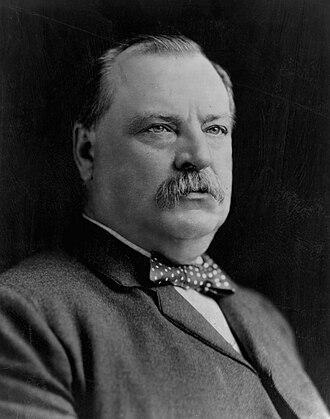
Signed by President Grover Cleveland on March 21, 1888, this order reads: To the United States Civil Service Commission. GENTLEMEN: I desire to make a suggestion regarding subdivision (c), General Rule III, of the amended civil-service rules promulgated February 2, 1888. It provides for the promotion of an employee in a Department who is below or outside of the classified service to a place within said classified service in the same Department upon the request of the appointing officer…
Constitutional Assessment: Scrutinized through Article II, Section 2, this action exercises the President's constitutional role as Commander in Chief. Early Framers recognized broad executive discretion in commanding military forces during conflict, provided it remains bounded by congressional declarations and respects civilian domestic courts.
Key Directives & Operative Actions
▪
GENTLEMEN: I desire to make a suggestion regarding subdivision (c), General Rule III, of the amended civil-service rules promulgated February 2, 1888.
▪
It provides for the promotion of an employee in a Department who is below or outside of the classified service to a place within said classified service in the same Department upon the request of the appointing officer, upon the recommendation of the Commission and the approval of the President, after a noncompetitive examination, in case such person has served continuously for two years in the place from which it is proposed to promote him, and "because of his faithfulness and efficiency in the position occupied by him," and "because of his qualifications for the place to which the appointing officer desires his promotion." It has occurred to me that this provision must be executed with caution to avoid the application of it to cases not…
▪
The cases arising under the exception above recited should be very few, and when presented they should precisely meet all the requirements specified, and should be supported by facts which will develop the basis and reason of the application of the appointing officer and which will commend them to the judgment of the Commission and the President.
▪
It seems that the only classification in the Department of State and the Department of Justice is that provided for by section 163 of the Revised Statutes, which directs that the employees in the several Departments shall be divided into four classes.
Constitutional & Societal Entities Impacted
🏛️ Armed Forces & Military Establishments
🏛️ Sovereign State Governments & Localities
🏛️ Executive Departments & Federal Civil Servants
🏛️ Private Citizens & Property Owners
🏛️ Financial Institutions & Monetary Authorities
Policy Areas & Topics
🏛️
The Framers' Constitutional Council
1787 PrismEvaluating this order against the constitutional debates of 1787 and the limits of Article II executive power.
⚖️✨ Zone 2 (Zone of Twilight)
§
"When the President acts in absence of either a congressional grant or denial of authority, he can only rely upon his own independent powers, but there is a zone of twilight in which he and Congress may have concurrent authority."
— Justice Robert H. Jackson, Youngstown Sheet & Tube Co. v. Sawyer (1952) Concurrent Authority / Congressional Silence
JM
James Madison
Separation of Powers & Legislative Primacy
"Power is of an encroaching nature, and it ought to be effectually restrained from passing the limits assigned to it." — Federalist No. 48 (1788)
Madison would view this order with watchful scrutiny. Operating in the 'Zone of Twilight' where Congress is silent, each such directive establishes an administrative precedent that steadily expands the executive perimeter at the expense of legislative primacy.
Madisonian Stance: Vigilant / Cautionary
AH
Alexander Hamilton
The Energetic Executive & Unified Command
"The direction of war implies the direction of the common strength; and the power of directing and employing the common strength must be under the direction of the single hand of the Executive." — Federalist No. 74 (1788)
Hamilton would forcefully champion executive discretion here. For foreign entanglements, commerce defense, and national security, deliberative assemblies are too slow and faction-ridden. A unified, energetic Executive exercising swift command is precisely what the Philadelphia Convention intended for national preservation.
Hamiltonian Stance: Strong Prerogative Support
GM
George Mason
Bill of Rights, Due Process & 10th Amendment
"The president will be surrounded by flatterers and sycophants... and the great powers of the executive will gradually absorb the liberties of the people." — Cato IV (Anti-Federalist, 1787)
The Anti-Federalist prism advises continuous democratic vigilance. Even routine administrative directives aggregate centralized federal power away from town halls and state assemblies toward a distant executive apparatus.
Anti-Federalist Stance: Eternal Vigilance Required
📐
Five Measurable "Constitutional Friction" Dimensions
An objective audit measuring potential separation-of-powers tension against the United States Constitution and established Supreme Court doctrine.
⚖️ Discretionary Twilight Zone
47 / 100 friction index
Dimension 1 • Art. I, §1 & §8
Moderate Friction
Legislative Encroachment & Purse
Administers commerce or fiscal programs requiring ongoing statutory delegation and legislative oversight.
Benchmark: Power of the purse, taxes/tariffs, and rule of law reserved to Congress.
Dimension 2 • Art. II, §1 & §3
Moderate Friction
Executive Scope & Faithfulness
Directs internal executive branch machinery, agency workflows, and federal personnel.
Benchmark: Faithfully execute laws enacted by Congress vs. unilateral decree.
Dimension 3 • 10th Amendment
Moderate Friction
Federalism & State Sovereignty
Engages state and local partners in cooperative federalism programs.
Benchmark: Police powers and un-delegated responsibilities reserved to the States.
Dimension 4 • 5th & 14th Amendments
Moderate Friction
Due Process & Individual Rights
Applies regulatory or compliance standards to private contractors or commercial entities.
Benchmark: Protection of private property, contracts, liberty, and procedural justice.
Dimension 5 • Separation of Powers
Moderate Friction
Youngstown Jacksonian Tier
The order relies on inherent Article II executive discretion, civil service management, or foreign diplomacy where Congress has neither expressly approved nor prohibited action.
Benchmark: Concurrent Authority / Congressional Silence
⚖️
Audit Synthesis
This order operates within Justice Jackson’s Zone of Twilight, resting upon concurrent presidential authority or congressional silence.
Weighted composite: Art. I (25%), Art. II (25%), Federalism (15%), Due Process (15%), Youngstown (20%).
ℹ️
How to read these dimensions: Executive power expands whenever an administration acts without explicit statutory authorization from Congress (Article I), touches upon police powers historically reserved to the states (Tenth Amendment), or limits private rights and property without judicial process. A low friction score indicates strict concordance with enacted law; a high friction score highlights orders testing the limits of presidential discretion.
Total Words
788
4,933 characters
Estimated Read Time
4 min
@ 200 words / min
Flesch-Kincaid
17.7
Post-Graduate Legal
Text size:
Related Executive Orders
Other executive actions signed by Grover Cleveland around this period.
Order
Mar 23, 1888
🏛️✅ Zone 1 (Maximum Authority) Constitutional Neutral
Executive Order
📜 Art. I §8: Delegated Tariff & Commerce Execution
The executive offices in Washington be closed on the day of the funeral and be draped in mourning for thirty days, and that the national flag be displayed at half-mast on the public buildings and on all national vessels on the day of the funeral.
 Grover Cleveland
College Level • 1m
Order
Mar 1, 1888
⚖️✨ Zone 2 (Zone of Twilight) Constitutional Neutral
Executive Order
📜 5th Amend: Regulatory Execution with Due Process
In the exercise of authority vested in the President by the seventeen hundred and fifty-third section of the Revised Statutes to prescribe such regulations for the admission of persons into the civil service of the United States as may best promote the efficiency thereof and…
Grover Cleveland Post-Graduate Legal • 2m
Order
Feb 2, 1888
⚖️✨ Zone 2 (Zone of Twilight) Constitutional Neutral
Executive Order
📜 Art. II §2: Commander-in-Chief Supervisory Authority
February 2, 1888. In the exercise of power vested in him by the Constitution and of authority given to him by the seventeen hundred and fifty-third section of the Revised Statutes and by an act to regulate and improve the civil service of the United States, approved January 16…
Grover Cleveland Post-Graduate Legal • 49m
Order
May 26, 1888
⚖️✨ Zone 2 (Zone of Twilight) Constitutional Neutral
Executive Order
📜 Art. II §1: Executive Discretion & Internal Operations
The several Executive Departments, the Department of Agriculture, and the Government Printing Office be closed on Wednesday, the 30th instant, to enable the employees to participate in the decoration of the graves of the soldiers who fell during the rebellion. GROVER CLEVELAND
Grover Cleveland Post-Graduate Legal • 1m
Order
Jun 5, 1888
🏛️✅ Zone 1 (Maximum Authority) Constitutional Neutral
Executive Order
📜 Art. I §8: Delegated Tariff & Commerce Execution
Washington, D.C., June 2, 1888. The PRESIDENT. SIR: In the force employed in the office of the collector of customs at the port of New York there are eight tellers who receive and count the money paid in at that office, amounting to $500,000 a day or upward, and who should be…
Grover Cleveland College Level • 1m
Order
Jun 18, 1888
⚖️✨ Zone 2 (Zone of Twilight) Constitutional Neutral
Executive Order
📜 Art. II §1: Executive Discretion & Internal Operations
In addition to the exceptions from examination in the classified postal service made by Postal Rule II, clause 5, the following exception to examination in that service is hereby made: Printers, employed as such.
Grover Cleveland Post-Graduate Legal • 1m
📜
Scholarly & Legal Citations
Exec. Order (Mar. 21, 1888), https://executiveordersarchive.org/orders/app-executive-order-228.
