By virtue of the authority vested in me by Chapter II of the act entitled "An Act to amend an Act entitled ‘An Act for making further and more effectual provision for the national defense, and for other purposes,' approved June 3, 1918, and to establish military justice," approved June 4, 1920 (41 Stat. 759, 787), and as President of the United States, the Manual for Courts-Martial, United States Army (1928), hereinafter referred to as the Manual, is hereby amended as follows: 1. The second subparagraph of paragraph 14 of the Manual is amended to read: "Under the authority of A. W. 13 commissioned officers and persons of equivalent relative or assimilated rank are hereby excepted from the jurisdiction of special courts-martial." 2. The last sentence in the second subparagraph of paragraph 85 a of the Manual is amended to read: "These notes may be destroyed after final disposition of the case under A. W. 48, 50½ or 51." 3. Paragraph 87 b of the Manual is amended by inserting the words "and privates first class" after the words "noncommissioned officers" in the seventh line of the second subparagraph. 4. Paragraph 87 c of the Manual is amended by striking out the last sentence of the third subparagraph, and by changing the first subparagraph to read: " c. Disposition of record and related matters.—General Court-Martial. The record, with the decisions and orders of the reviewing authority thereon, will be transmitted, ordinarily without letter of transmittal, direct to The Judge Advocate General of the Army. With the record will be forwarded the accompanying papers (see 85), six authenticated copies of the order, if there be any, promulgating the result of the trial, and two signed copies of the review of the staff judge advocate. In cases involving more than one accused an additional copy of the order of promulgation, if any, will be forwarded for each additional accused. This applies equally to cases in which the sentence is suspended under A. W. 51, but where action by a confirming authority other than the President is necessary, the record, etc., will be transmitted to such authority. Where the order of execution is withheld under A. W. 50½ the reviewing authority will, before forwarding the record, take therefrom the data necessary for drafting a general court-martial order, and when such order is issued the same number of copies thereof will be forwarded as in the case of an order not so withheld." 5. Paragraph 91 of the Manual is amended by striking out the last two sentences and inserting in lieu thereof the following : "Special and summary court records shall be retained in the office of the staff judge advocate until notification is received that their destruction has been authorized under the provisions of the act of August 5, 1939, 53 Stat. 1219, or that The Judge Advocate General of the Army has authorized their storage elsewhere." 6. Paragraph 94 of the Manual is amended by striking out the second subparagraph. 7. Paragraph 96 of the Manual is amended by striking out the second subparagraph and inserting in lieu thereof the following: "Any officer of any component of the Army of the United States on active duty in Federal service commissioned in or assigned or detailed to duty with the Judge Advocate General's Department, any staff judge advocate or acting staff judge advocate, the President of a general or special court-martial, any summary court-martial, the trial judge advocate or any assistant trial judge advocate of a general or special court-martial, the president or the recorder of a court of inquiry or of a military board, any officer designated to take a deposition, any officer detailed to conduct an investigation, and the adjutant, assistant adjutant, or personnel adjutant of any command shall have power to administer oaths for the purposes of the administration of military justice and for other purposes of military administration; and shall also have the general powers of a notary public in the administration of oaths, the execution and acknowledgment of legal instruments, the attestation of documents and all other forms of notarial acts to be executed by persons subject to military law. (A. W. 114.) "A warrant officer serving as assistant adjutant of any command has power to administer oaths for all purposes of military administration. (Sec. 4, act of Aug. 21, 1941, 55 Stat. 653)" 8. Paragraph 103 d of the Manual is amended by inserting the words "or private first class" after the words "noncommissioned officer" and before the comma in the third line, and after the words "noncommissioned officer" in the seventh line. 9. Paragraph 125 of the Manual is amended by adding to the fourth subparagraph the words "the seal of The Adjutant General's Office;", and by inserting the following subparagraph after the ninth subparagraph thereof: "The seal of The Adjutant General's Office on a certificate is prima facie evidence that the signature thereon is that of The Adjutant General or one of his assistants." 10. Paragraph 129 of the Manual is amended by deleting from the fourth subparagraph of the subparagraph entitled "Proof" the sentence reading "As to who are such assistants reference may be had to the Army List and Directory." 11. Paragraph 155 of the Manual is amended by striking out the words "The Adjutant General" in the third line and inserting in lieu thereof the words "The Judge Advocate General". 12. Appendix 4 of the Manual is amended by inserting "(per os) (per anum)" immediately after the word "connection" in the third line of Form 98. 13. Appendix 10, paragraph a , of the Manual is amended by inserting the words "in violation of Article of War 61," immediately after the comma before the words "is approved" in the third line of Form 4, and by inserting the words "and will be duly executed" after the word "approved" and before the comma in the first line of Form 6. FRANKLIN D ROOSEVELT The White House, March 31, 1943.
Executive Order 9324 ⚖️✨ Zone 2: Zone of Twilight Constitutional Neutral (+0.02)
📜 Art. II §2: Commander-in-Chief Supervisory Authority
Executive Order 9324—Amending the Manual for Courts-Martial, United States Army (1928)
Executive Brief • At a Glance
⏱️ 5 min read (997 words) •
● In Effect
🎯 Primary Mandate
The Manual for Courts-Martial, United States Army (1928), hereinafter referred to as the Manual, is hereby amended as follows: 1.
⚖️ Constitutional Footing
⚖️✨ Zone 2: Zone of Twilight
Concurrent Authority / Congressional Silence
📜 Art. II §2: Commander-in-Chief Supervisory Authority
🏛️ Scope & Affected Sectors
Armed Forces & Military Establishments Executive Departments & Federal Civil Servants Private Citizens & Property Owners
Plain-English Translation & Framers' Constitutional Analysis
Early Statesman synthesis distilling legal jargon into practical meaning, statutory anchors, and structural constitutional impacts.
Signed by President Franklin D. Roosevelt on March 31, 1943, this order concerns Amending the Manual for Courts-Martial, United States Army (1928). The Manual for Courts-Martial, United States Army (1928), hereinafter referred to as the Manual, is hereby amended as follows: 1. The second subparagraph of paragraph 14 of the Manual is amended to read: "Under the authority of A. W. 13 commissioned officers and persons of equivalent relative or assimilated rank are hereby excepted from the jurisdiction of special courts-martial." 2.
Constitutional Assessment: Scrutinized through Article II, Section 2, this action exercises the President's constitutional role as Commander in Chief. Early Framers recognized broad executive discretion in commanding military forces during conflict, provided it remains bounded by congressional declarations and respects civilian domestic courts.
Key Directives & Operative Actions
▪
The Manual for Courts-Martial, United States Army (1928), hereinafter referred to as the Manual, is hereby amended as follows: 1.
▪
The second subparagraph of paragraph 14 of the Manual is amended to read: "Under the authority of A. W. 13 commissioned officers and persons of equivalent relative or assimilated rank are hereby excepted from the jurisdiction of special courts-martial." 2.
▪
The last sentence in the second subparagraph of paragraph 85 a of the Manual is amended to read: "These notes may be destroyed after final disposition of the case under A. W. 48, 50½ or 51." 3.
▪
Paragraph 87 b of the Manual is amended by inserting the words "and privates first class" after the words "noncommissioned officers" in the seventh line of the second subparagraph. 4.
Constitutional & Societal Entities Impacted
🏛️ Armed Forces & Military Establishments
🏛️ Executive Departments & Federal Civil Servants
🏛️ Private Citizens & Property Owners
Policy Areas & Topics
🏛️
The Framers' Constitutional Council
1787 PrismEvaluating this order against the constitutional debates of 1787 and the limits of Article II executive power.
⚖️✨ Zone 2 (Zone of Twilight)
§
"When the President acts in absence of either a congressional grant or denial of authority, he can only rely upon his own independent powers, but there is a zone of twilight in which he and Congress may have concurrent authority."
— Justice Robert H. Jackson, Youngstown Sheet & Tube Co. v. Sawyer (1952) Concurrent Authority / Congressional Silence
JM
James Madison
Separation of Powers & Legislative Primacy
"Power is of an encroaching nature, and it ought to be effectually restrained from passing the limits assigned to it." — Federalist No. 48 (1788)
Madison would view this order with watchful scrutiny. Operating in the 'Zone of Twilight' where Congress is silent, each such directive establishes an administrative precedent that steadily expands the executive perimeter at the expense of legislative primacy.
Madisonian Stance: Vigilant / Cautionary
AH
Alexander Hamilton
The Energetic Executive & Unified Command
"The direction of war implies the direction of the common strength; and the power of directing and employing the common strength must be under the direction of the single hand of the Executive." — Federalist No. 74 (1788)
Hamilton would forcefully champion executive discretion here. For foreign entanglements, commerce defense, and national security, deliberative assemblies are too slow and faction-ridden. A unified, energetic Executive exercising swift command is precisely what the Philadelphia Convention intended for national preservation.
Hamiltonian Stance: Strong Prerogative Support
GM
George Mason
Bill of Rights, Due Process & 10th Amendment
"The president will be surrounded by flatterers and sycophants... and the great powers of the executive will gradually absorb the liberties of the people." — Cato IV (Anti-Federalist, 1787)
The Anti-Federalist prism advises continuous democratic vigilance. Even routine administrative directives aggregate centralized federal power away from town halls and state assemblies toward a distant executive apparatus.
Anti-Federalist Stance: Eternal Vigilance Required
📐
Five Measurable "Constitutional Friction" Dimensions
An objective audit measuring potential separation-of-powers tension against the United States Constitution and established Supreme Court doctrine.
⚖️ Discretionary Twilight Zone
43 / 100 friction index
Dimension 1 • Art. I, §1 & §8
Moderate Friction
Legislative Encroachment & Purse
Administers commerce or fiscal programs requiring ongoing statutory delegation and legislative oversight.
Benchmark: Power of the purse, taxes/tariffs, and rule of law reserved to Congress.
Dimension 2 • Art. II, §1 & §3
Moderate Friction
Executive Scope & Faithfulness
Directs internal executive branch machinery, agency workflows, and federal personnel.
Benchmark: Faithfully execute laws enacted by Congress vs. unilateral decree.
Dimension 3 • 10th Amendment
Moderate Friction
Federalism & State Sovereignty
Engages state and local partners in cooperative federalism programs.
Benchmark: Police powers and un-delegated responsibilities reserved to the States.
Dimension 4 • 5th & 14th Amendments
Low Friction
Due Process & Individual Rights
Focuses on internal governmental operations with no direct impairment of private rights or property.
Benchmark: Protection of private property, contracts, liberty, and procedural justice.
Dimension 5 • Separation of Powers
Moderate Friction
Youngstown Jacksonian Tier
The order relies on inherent Article II executive discretion, civil service management, or foreign diplomacy where Congress has neither expressly approved nor prohibited action.
Benchmark: Concurrent Authority / Congressional Silence
⚖️
Audit Synthesis
This order operates within Justice Jackson’s Zone of Twilight, resting upon concurrent presidential authority or congressional silence.
Weighted composite: Art. I (25%), Art. II (25%), Federalism (15%), Due Process (15%), Youngstown (20%).
ℹ️
How to read these dimensions: Executive power expands whenever an administration acts without explicit statutory authorization from Congress (Article I), touches upon police powers historically reserved to the states (Tenth Amendment), or limits private rights and property without judicial process. A low friction score indicates strict concordance with enacted law; a high friction score highlights orders testing the limits of presidential discretion.
Total Words
997
5,953 characters
Estimated Read Time
5 min
@ 200 words / min
Flesch-Kincaid
17.1
Post-Graduate Legal
Text size:
Related Executive Orders
Other executive actions signed by Franklin D. Roosevelt around this period.
EO 9323 Mar 31, 1943
⚖️✨ Zone 2 (Zone of Twilight) Constitutional Neutral
Executive Order 9323—Amendment of Executive Order No. 8809 of June 28, 1941, Establishing the Good Conduct Medal
📜 Art. II §2: Commander-in-Chief Supervisory Authority
"There is hereby established the Good Conduct Medal, which shall include suitable appurtenances. Such medal may be awarded for exemplary behavior, efficiency, and fidelity, under such regulations as the Secretary of War shall prescribe, to those enlisted men of the Army of the…
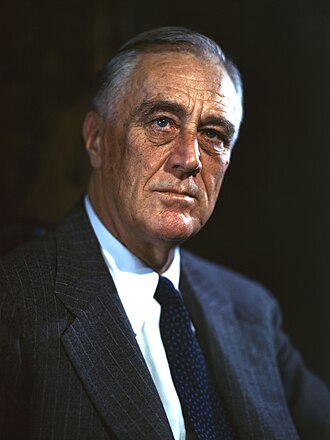 Franklin D. Roosevelt
Post-Graduate Legal • 1m
EO 9322 Mar 26, 1943
⚖️✨ Zone 2 (Zone of Twilight) Constitutional Neutral
Executive Order 9322—Centralizing and Delegating Authority With Respect to the Production and Distribution of Food
📜 Art. II §2: Commander-in-Chief Supervisory Authority
The Food Production Administration (except the Farm Credit Administration), the Food Distribution Administration, the Commodity Credit Corporation, and the Extension Service are hereby consolidated within the Department of Agriculture into an Administration of Food Production…
Franklin D. Roosevelt Post-Graduate Legal • 2m
EO 9321 Mar 25, 1943
⚖️✨ Zone 2 (Zone of Twilight) Constitutional Neutral
Executive Order 9321—Authorizing the Attorney General To Acquire and Dispose of Property
📜 Art. II §2: Commander-in-Chief Supervisory Authority
The Attorney General is hereby authorized to exercise the authority contained in said Title II of the Second War Powers Act, 1942, to acquire, use, and dispose of any real property, temporary use thereof, or other interest therein, together with any personal property located…
Franklin D. Roosevelt Post-Graduate Legal • 1m
EO 9327 Apr 7, 1943
⚖️✨ Zone 2 (Zone of Twilight) Constitutional Neutral
Executive Order 9327—Providing for the More Effective Handling of Governmental Problems in Congested Production Areas in Order To Further the Successful Prosecution of the War
📜 Art. II §2: Commander-in-Chief Supervisory Authority
For the purposes of this Order a congested production area is an area which, by reason of a large increase in population and activity due to the war, is lacking in adequate services or facilities. 2.
Franklin D. Roosevelt Post-Graduate Legal • 4m
EO 9326 Apr 7, 1943
⚖️✨ Zone 2 (Zone of Twilight) Constitutional Neutral
Executive Order 9326—Transect of Jurisdiction Over Certain Land Containing Oil and Gas Deposits From the War Department to the Department of the Interior
📜 Art. II §2: Commander-in-Chief Supervisory Authority
The jurisdiction over the oil and gas deposits in the following-described land in the State of California is hereby transferred from the War Department to the Department of the Interior: A tract of land 600 feet wide known as the Cerritos Channel, lying partly within the…
Franklin D. Roosevelt College Level • 2m
EO 9325 Apr 7, 1943
⚖️✨ Zone 2 (Zone of Twilight) Constitutional Neutral
Executive Order 9325—Payment of Expenses of the Office of Alien Property Custodian
📜 Art. II §2: Commander-in-Chief Supervisory Authority
Until it is otherwise provided, the Alien Property Custodian is authorized and empowered to pay out of any funds lawfully in his custody or under his control all necessary expenses incurred by the Office of Allen Property Custodian in carrying out the powers and duties vested…
Franklin D. Roosevelt Post-Graduate Legal • 2m
📜
Scholarly & Legal Citations
Exec. Order No. 9324 (Mar. 31, 1943), https://executiveordersarchive.org/orders/app-executive-order-9324-amending-the-manual-for-courts-martial-united-states-army-1928.
