By virtue of the authority vested in me by the Constitution and statutes of the United States of America, including Section 805 of the Foreign Service Act of 1946, as added by Section 503 of Public Law 94-350 (90 Stat. 835; 22 U.S.C. 1065), and as President of the United States of America, in order to conform the Foreign Service Retirement and Disability System to certain amendments to the Civil Service Retirement and Disability System, it is hereby ordered as follows: SECTION 1. (a) The enactment (subsequent to January 1, 1974) of the following laws has affected a provision of general applicability in the Civil Service Retirement and Disability System (subchapter III, chapter 83 of Title 5 of the United States Code) or otherwise affected current or former participants, annuitants, or survivors under that System which, immediately prior to the enactment of such laws, had been substantially identical to a corresponding provision of law affecting participants, former participants, annuitants or survivors under the Foreign Service Retirement and Disability System: (1) Section 1 of Public Law 93-260, approved April 9, 1974 (88 Stat. 76). (2) Section 1 of Public Law 93-273, approved April 26, 1974 (88 Stat. 93). (3) Section 2 of Public Law 93-273, approved April 26, 1974 (88 Stat. 93). (4) Public Law 93-474, approved October 26, 1974 (88 Stat. 1438). (5) Public Law 94-166, approved December 23, 1975 (89 Stat. 1002). (b) The provisions of the laws cited in subsection (a) above are extended, as provided by Section 805 of the Foreign Service Act of 1946, as amended (22 U.S.C. 1065),. to the Foreign Service Retirement and Disability System in accordance with the provisions of this Order, which provisions shall modify, supersede, or render inapplicable all inconsistent prior provisions of law. SEC. 2. (a) In accord with Section 1 of Public Law 93-260, Section 804(b) of the Foreign Service Act of 1946, as amended (22 U.S.C. 1064(b) ), is deemed to be amended by striking out "two years" wherever it appears and inserting in lieu thereof "one year". This amendment shall apply only in the cases of participants, former participants, or annuitants who died on or after April 9, 1974 but no annuity shall be paid or recomputed, by virtue of this amendment, for any period prior to May 1, 1974. (b) In accord with Section 1 of Public Law 93-273, and notwithstanding any other provision of Section 821 of the Foreign Service Act of 1946, as amended (22 U.S.C. 1076), said Section 821 shall be deemed to be amended to provide for the payment of a minimum annuity as follows: (1) The monthly rate of an annuity payable, under said Section 821, to an annuitant, or to a survivor annuitant other than a child, shall not be less than the smallest primary insurance amount, including any cost of living increase added to that amount, authorized to be paid from time to time under Title II of the Social Security Act (42 U.S.C. 401 et seq.). (2) The monthly rate of an annuity payable, under said Section 821, to a surviving child shall not be less than the smallest primary insurance amount, including any cost of living increase added to that amount, authorized to be paid from time to time under Title II of the Social Security Act (42 U.S.C. 401 et seq. ), or three times such primary insurance amount divided by the number of surviving children entitled to an annuity, whichever is the lesser. (3) The provisions of this subsection shall not apply to an annuitant or to a survivor who is or becomes entitled to receive from the United States an annuity or retired pay under any other civilian or military retirement system, benefits under Title II of the Social Security Act (42 U.S.C. 401 et seq.), a pension, veterans' compensation, or any other periodic payment of a similar nature, when the monthly rate thereof is equal to or greater than the smallest primary insurance amount, including any cost of living increase added to that amount, authorized to be paid from time to time under Title II of the Social Security Act (42 U.S.C. 401 et seq.). (4) The provisions of this subsection apply to all annuities, whether commenced before, on, or after August 1, 1974, but no increase in any annuity shall be paid or recomputed under this subsection for any period prior to August 1, 1974. (c) In accord with Section 2 of Public Law 93-273, Section 821 of the Foreign Service Act of 1946, as amended (22 U.S.C. 1076), shall be deemed to be amended to provide an increase in annuities, which have been computed on the highest five consecutive years of service, as follows: (1) An annuity payable to a former participant which is based on a separation occurring prior to October 20, 1969, is increased by $240.00. (2) In lieu of any increase based on an increase under paragraph (1) of this subsection, an annuity to the surviving spouse of a participant or annuitant which is based on a. separation occurring prior to October 20, 1969, is increased by $132.00. (3) The provisions of this subsection shall not apply to annuities payable under Section 523 (c) of Public Law 94-350 (90 Stat. 847, 22 U.S.C. 1076 note), or any similar prior provision of law, to the surviving spouse of a participant or annuitant. (4) The monthly rate of an annuity resulting from an increase under this subsection shall be considered as the monthly rate of annuity payable under Section 821 of the Foreign Service Act of 1946, as amended (22 U.S.C. 1076), for purposes of computing the minimum annuity as provided in subsection (b) of this Section. (5) The provisions of this subsection apply to all annuities, whether commenced before, on, or after August 1, 1974, but no increase in any annuity shall be paid or recomputed under this subsection for any period prior to August 1, 1974. (d) In accord with Public Law 93-474, Section 821 of the Foreign Service Act of 1946, as amended (22 U.S.C. 1076), shall be deemed to be amended to provide for the recomputation of annuities for nonmarried annuitants, as follows: (1) An annuity which is reduced under Section 821(b) (1) of the Foreign Service Act of 1946, as amended (22 U.S.C. 1076(b) (1), or any similar prior provision of law shall, for each full month during which a retired participant is not married, be recomputed and paid as if the annuity had not been so reduced. Upon remarriage of the retired participant, the annuity shall be reduced by the same percentage reductions which were in effect at the time of retirement or, if such percentage reductions were subsequently adjusted pursuant to law, by the percentage reductions last made pursuant to law. (2) The provisions of this subsection apply to all annuities, whether commenced before, on, or after November 1, 1974, but no increase in any annuity shall be paid or recomputed under this subsection for any period prior to November 1, 1974. (e) In accord with Public Law 94-166, Section 864 of the Foreign Service Act of 1946, as amended (22 U.S.C. 1104), is deemed to be amended by adding a subsection (a) and conforming the present Section as subsection (b), to read as follows: "Sec. 864 (a) An individual entitled to an annuity from the Fund may make allotments or assignments of amounts from such annuity for such purposes as the Secretary in his sole discretion considers appropriate. "(b) None of the moneys mentioned in this title shall be assignable, either in law or equity, except under the provisions of subsection (a) of this Section or Section 634(c), or subject to execution, levy, attachment, garnishment, or other legal process, except as otherwise may be provided by Federal laws." GERALD R. FORD The White House, January 7, 1977.
Executive Order 11952 🏛️✅ Zone 1: Maximum Authority Constitutional Fidelity (+0.50)
📜 Art. II §2: Commander-in-Chief Supervisory Authority
Executive Order 11952—Conforming the Foreign Service and Civil Service Retirement and Disability Systems
Executive Brief • At a Glance
⏱️ 7 min read (1,305 words) •
● In Effect
🎯 Primary Mandate
The enactment (subsequent to January 1, 1974) of the following laws has affected a provision of general applicability in the Civil Service Retirement and Disability System (subchapter III, chapter 83 of Title 5 of the United States Code) or otherwise affected current or former participants, annuitants, or survivors under that System which, immediately prior to the enactment of such laws, had been substantially identical to a corresponding provision of law affecting participants, former participants, annuitants or survivors under the Foreign Service Retirement and Disability System: (1) Section 1 of Public Law 93-260, approved April 9, 1974 (88 Stat. 76).
⚖️ Constitutional Footing
🏛️✅ Zone 1: Maximum Authority
Express or Implied Congressional Authorization
📜 Art. II §2: Commander-in-Chief Supervisory Authority
🏛️ Scope & Affected Sectors
Armed Forces & Military Establishments Executive Departments & Federal Civil Servants Private Citizens & Property Owners Foreign Nations & International Entities
Plain-English Translation & Framers' Constitutional Analysis
Early Statesman synthesis distilling legal jargon into practical meaning, statutory anchors, and structural constitutional impacts.
Signed by President Gerald R. Ford on January 7, 1977, this order concerns Conforming the Foreign Service and Civil Service Retirement and Disability Systems. The enactment (subsequent to January 1, 1974) of the following laws has affected a provision of general applicability in the Civil Service Retirement and Disability System (subchapter III, chapter 83 of Title 5 of the United States Code) or otherwise affected current or former participants, annuitants, or survivors under that System which, immediately prior to the enactment of such laws, had been substantially…
Constitutional Assessment: Scrutinized through Article II, Section 2, this action exercises the President's constitutional role as Commander in Chief. Early Framers recognized broad executive discretion in commanding military forces during conflict, provided it remains bounded by congressional declarations and respects civilian domestic courts.
Key Directives & Operative Actions
▪
The enactment (subsequent to January 1, 1974) of the following laws has affected a provision of general applicability in the Civil Service Retirement and Disability System (subchapter III, chapter 83 of Title 5 of the United States Code) or otherwise affected current or former participants, annuitants, or survivors under that System which, immediately prior to the enactment of such laws, had been substantially identical to a corresponding provision of law affecting participants, former participants, annuitants or survivors under the Foreign Service Retirement and Disability System: (1) Section 1 of Public Law 93-260, approved April 9, 1974 (88 Stat. 76).
▪
Section 1 of Public Law 93-273, approved April 26, 1974 (88 Stat. 93).
▪
Section 2 of Public Law 93-273, approved April 26, 1974 (88 Stat. 93).
▪
Public Law 93-474, approved October 26, 1974 (88 Stat. 1438).
Constitutional & Societal Entities Impacted
🏛️ Armed Forces & Military Establishments
🏛️ Executive Departments & Federal Civil Servants
🏛️ Private Citizens & Property Owners
🏛️ Foreign Nations & International Entities
🏛️
The Framers' Constitutional Council
1787 PrismEvaluating this order against the constitutional debates of 1787 and the limits of Article II executive power.
🏛️✅ Zone 1 (Maximum Authority)
§
"When the President acts pursuant to an express or implied authorization of Congress, his authority is at its maximum, for it includes all that he possesses in his own right plus all that Congress can delegate."
— Justice Robert H. Jackson, Youngstown Sheet & Tube Co. v. Sawyer (1952) Express or Implied Congressional Authorization
JM
James Madison
Separation of Powers & Legislative Primacy
"The constitutional magistracy was designed not to invent policy, but to be the faithful instrument of the laws passed by the people's representatives." — Speech in the First Congress (1789)
Madison would approve the structural posture of this order. The President acts strictly in subordination to statutory authority granted under Article II, Section 3 ("take Care that the Laws be faithfully executed"). The checks and balances hold firm because the policy origin remains with the legislature.
Madisonian Stance: Concurring (Statutory)
AH
Alexander Hamilton
The Energetic Executive & Unified Command
"The direction of war implies the direction of the common strength; and the power of directing and employing the common strength must be under the direction of the single hand of the Executive." — Federalist No. 74 (1788)
Hamilton would forcefully champion executive discretion here. For foreign entanglements, commerce defense, and national security, deliberative assemblies are too slow and faction-ridden. A unified, energetic Executive exercising swift command is precisely what the Philadelphia Convention intended for national preservation.
Hamiltonian Stance: Strong Prerogative Support
GM
George Mason
Bill of Rights, Due Process & 10th Amendment
"The president will be surrounded by flatterers and sycophants... and the great powers of the executive will gradually absorb the liberties of the people." — Cato IV (Anti-Federalist, 1787)
The Anti-Federalist prism advises continuous democratic vigilance. Even routine administrative directives aggregate centralized federal power away from town halls and state assemblies toward a distant executive apparatus.
Anti-Federalist Stance: Eternal Vigilance Required
📐
Five Measurable "Constitutional Friction" Dimensions
An objective audit measuring potential separation-of-powers tension against the United States Constitution and established Supreme Court doctrine.
⚖️ Discretionary Twilight Zone
48 / 100 friction index
Dimension 1 • Art. I, §1 & §8
High Friction
Legislative Encroachment & Purse
Touches upon core congressional prerogatives: raises appropriations reallocation, tariff imposition, or statutory preemption questions.
Benchmark: Power of the purse, taxes/tariffs, and rule of law reserved to Congress.
Dimension 2 • Art. II, §1 & §3
Moderate Friction
Executive Scope & Faithfulness
Directs internal executive branch machinery, agency workflows, and federal personnel.
Benchmark: Faithfully execute laws enacted by Congress vs. unilateral decree.
Dimension 3 • 10th Amendment
Moderate Friction
Federalism & State Sovereignty
Engages state and local partners in cooperative federalism programs.
Benchmark: Police powers and un-delegated responsibilities reserved to the States.
Dimension 4 • 5th & 14th Amendments
Moderate Friction
Due Process & Individual Rights
Applies regulatory or compliance standards to private contractors or commercial entities.
Benchmark: Protection of private property, contracts, liberty, and procedural justice.
Dimension 5 • Separation of Powers
Low Friction
Youngstown Jacksonian Tier
The President operates strictly as the constitutional Chief Executive, carrying out policy established by Congress with strong statutory backing.
Benchmark: Express or Implied Congressional Authorization
⚖️
Audit Synthesis
This order operates within Justice Jackson’s Zone of Twilight, resting upon concurrent presidential authority or congressional silence.
Weighted composite: Art. I (25%), Art. II (25%), Federalism (15%), Due Process (15%), Youngstown (20%).
ℹ️
How to read these dimensions: Executive power expands whenever an administration acts without explicit statutory authorization from Congress (Article I), touches upon police powers historically reserved to the states (Tenth Amendment), or limits private rights and property without judicial process. A low friction score indicates strict concordance with enacted law; a high friction score highlights orders testing the limits of presidential discretion.
Total Words
1,305
7,657 characters
Estimated Read Time
7 min
@ 200 words / min
Flesch-Kincaid
15.5
College Level
Text size:
🔗
Referenced By Later Executive Orders (1)
Subsequent presidents who cited, amended, continued, or revoked this directive in later orders.
Jimmy Carter • 1979-07-18
Related Executive Orders
Other executive actions signed by Gerald R. Ford around this period.
EO 11954 Jan 7, 1977
⚖️✨ Zone 2 (Zone of Twilight) Constitutional Neutral
Executive Order 11954—Federal Property Review
📜 5th Amend: Regulatory Execution with Due Process
The Federal Property Council (hereinafter referred to as the Council) is hereby reconstituted in the Executive Office of the President. The Council shall consist of the Director of the Office of Management and Budget, who shall be its Chairman, the Chairman of the Council of…
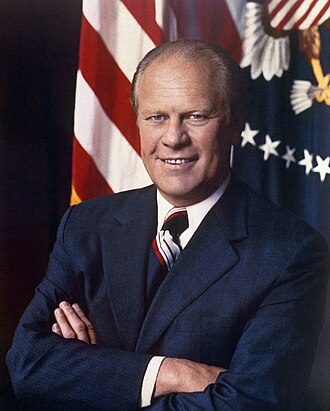 Gerald R. Ford
Post-Graduate Legal • 3m
EO 11953 Jan 7, 1977
⚖️⚠️ Zone 3 (Lowest Ebb) Friction (-0.19)
Executive Order 11953—Assigning Emergency Preparedness Functions to the Energy Research and Development Administration and Nuclear Regulatory Commission
📜 Art. II §2: Commander-in-Chief / War Prerogative Tension
Executive Order No. 11490 of October 28, 1969, as amended by Executive Order No. 11921 of June 11, 1976, is hereby further amended as follows: SECTION 1.
Gerald R. Ford Post-Graduate Legal • 7m
EO 11951 Jan 6, 1977
⚖️✨ Zone 2 (Zone of Twilight) Constitutional Neutral
Executive Order 11951—Relating to the Arrangement Regarding International Trade in Textiles
📜 Art. II §1: Executive Discretion & Internal Operations
(c) of Executive Order No. 11651 of March 3, 1972, is amended by deleting "Articles 3 and 6 of the Long Term Arrangement Regarding International Trade in Cotton Textiles done at Geneva on February 9, 1962, as extended," and substituting "Articles 3 and 8 of the Arrangement…
Gerald R. Ford Post-Graduate Legal • 1m
EO 11950 Jan 6, 1977
⚖️✨ Zone 2 (Zone of Twilight) Constitutional Neutral
Executive Order 11950—Conforming the Central Intelligence Agency and Civil Service Retirement and Disability Systems With Respect to Cost of Living Adjustments
📜 Art. II §2: Commander-in-Chief Supervisory Authority
The Director of Central Intelligence shall: (a) on January 1 of each year, or within a reasonable time thereafter, determine the percent change in the price index published for December of the preceding year over the price index published for June of the preceding year, and (b)…
Gerald R. Ford Post-Graduate Legal • 2m
EO 11955 Jan 10, 1977
⚖️✨ Zone 2 (Zone of Twilight) Constitutional Neutral
Executive Order 11955—Permitting Certain Qualified Employees of the National Aeronautics and Space Administration to be Given Career or Career-Conditional Appointment
📜 Art. II §3: Administrative Management & Civil Service
The appointment of a Command Pilot, Pilot or Mission Specialist candidate to a position in the Space Shuttle Astronaut Program of the National Aeronautics and Space Administration, which is listed under Schedule B of the Schedule of Excepted Positions, may be converted to…
Gerald R. Ford Post-Graduate Legal • 1m
EO 11957 Revoked Jan 13, 1977
⚖️✨ Zone 2 (Zone of Twilight) Constitutional Neutral
Executive Order 11957—Designation of Certain Officers to Act as Secretary of Agriculture
📜 Art. II §1: Executive Discretion & Internal Operations
During any period when, by reason of absence, disability, or vacancy in office, both the Secretary of Agriculture and the Deputy Secretary of Agriculture are not available to exercise the powers or perform the duties of the Office of Secretary, the officers from the Department…
Gerald R. Ford Post-Graduate Legal • 1m
📜
Scholarly & Legal Citations
Exec. Order No. 11,952 (Jan. 7, 1977), https://executiveordersarchive.org/orders/app-executive-order-11952-conforming-the-foreign-service-and-civil-service-retirement-and.
